Most software systems do not fail because they were poorly written on day one. They fail because they become too expensive to change on day one thousand.
That is the part of software architecture we do not talk about enough.
We love to debate frameworks, programming languages, cloud platforms, deployment models, database engines, and whether the system should be a monolith, microservices, serverless, event-driven, or something else entirely. Those discussions matter, but they often miss the bigger architectural question:
Can this system be changed without tearing the whole thing apart?
That question is where many software architectures expose their real weakness.
A system can be technically modern and still be rigid. It can run in containers, use Kubernetes, expose APIs, and have dozens of microservices while still behaving like a giant monolith. It can look cloud-native on the architecture diagram while still forcing every meaningful change through a chain of dependencies, regression risks, shared contracts, release coordination, and database assumptions.
That is not modernization. That is just distributed complexity.
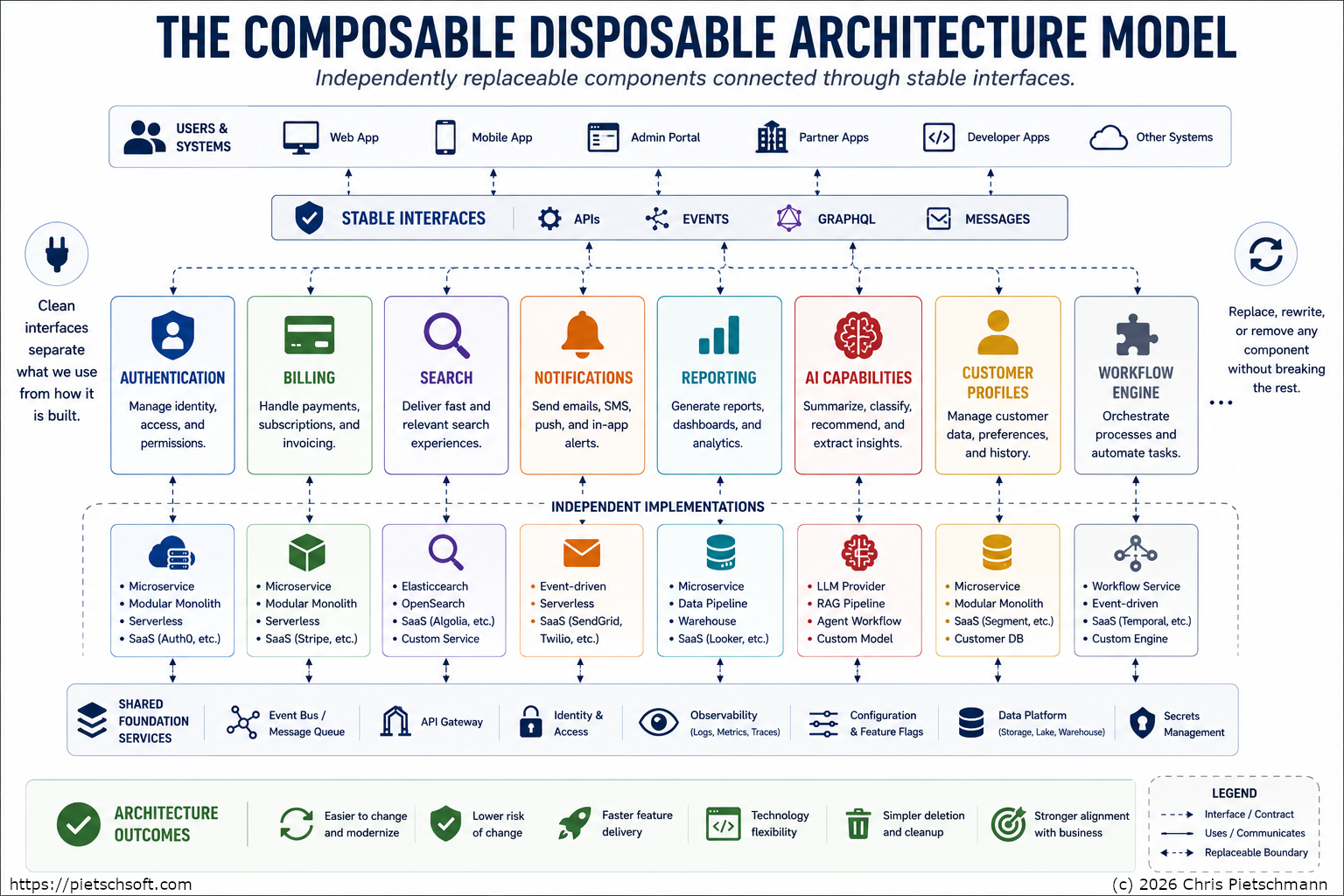
I believe software systems should be built as both composable and disposable solutions. Each part of the system should have a clear purpose, a clear interface, and a clear path to replacement. If a component no longer serves the business, it should be possible to rewrite it, remove it, or swap it out without destabilizing everything around it.
This does not mean building throwaway software carelessly. It means designing software with the expectation that change is inevitable.
The best systems are not the ones that last forever unchanged. The best systems are the ones that allow parts of themselves to be replaced over time without requiring a full-scale rebuild.
Composable and Disposable Software Architecture
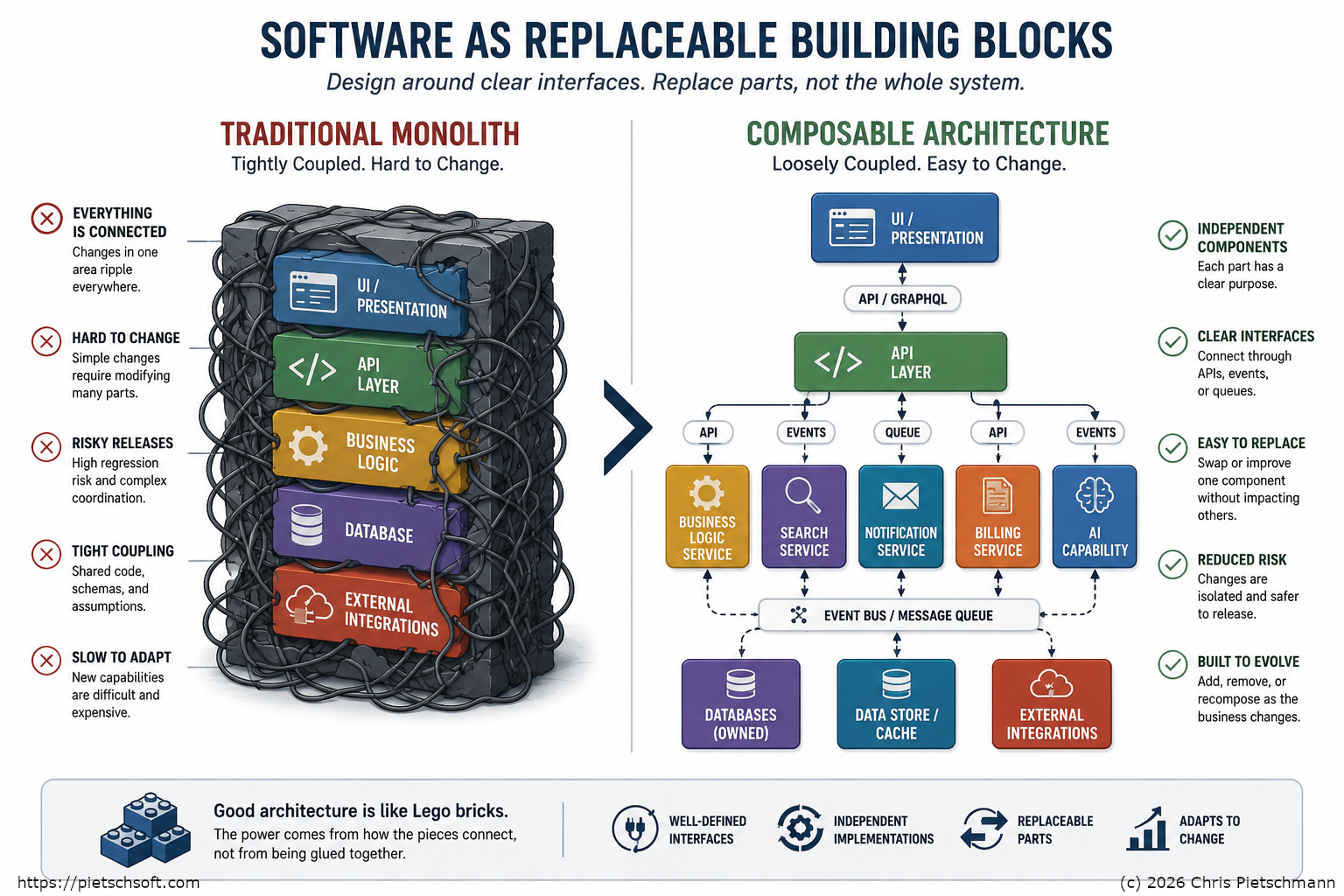
Composable software is built from independent pieces that fit together through well-defined interfaces. Think of Lego bricks. Each piece has its own shape, purpose, and boundary, but the real power comes from how the pieces connect.
The key is not that every brick is identical. The key is that the connection model is predictable.
In software, those connection points are interfaces, APIs, contracts, events, endpoints, message queues, schemas, protocols, and abstraction layers. As long as the integration points are stable and intentional, the internal implementation of each component can evolve independently.
Disposable software takes this idea one step further.
A disposable component is not disposable because it is low quality. It is disposable because it is replaceable. It performs its intended job, but it is not treated as sacred. When the business changes, the technology ages, the workload shifts, or the team learns a better way to solve the problem, that component can be rewritten or removed without forcing a redesign of the entire system.
This is a very different mindset from traditional enterprise software architecture.
Many organizations still build systems as if the goal is permanence. They select a platform, design a data model, build the user interface, add the business logic, wire everything together, and then keep expanding the same system year after year. Eventually, the system becomes central to the business, but also nearly impossible to change.
Every new feature touches old assumptions. Every rewrite becomes too risky. Every integration adds another dependency. Every team learns to work around the architecture instead of improving it.
That is how software becomes legacy.
Legacy is not simply old code. Legacy is code that cannot be safely changed.
Composable and disposable architecture is about avoiding that trap from the beginning. It recognizes that software has a lifecycle. Some parts of the system may last for years. Others may only be useful for a product cycle, a customer segment, a compliance requirement, a workflow experiment, or an integration with a vendor that may later be replaced.
If we know software will change, then architecture should be designed around replacement.
This applies at every layer of the system.
At the user interface layer, a web app, mobile app, admin portal, or customer dashboard should not be permanently fused to the backend implementation. If the UI needs to be redesigned, modernized, or rebuilt in a new framework, that should not require rewriting the core business logic.
At the API and service layer, business capabilities should be exposed through clear contracts. The internal implementation can change, but consumers should not need to know whether the capability is powered by a monolith, microservice, workflow engine, AI agent, serverless function, or third-party SaaS platform.
At the data layer, storage decisions should be isolated behind appropriate abstractions. A database is not just a persistence mechanism; it often becomes the hidden coupling point of the entire system. If every layer knows the database schema directly, then the database becomes the architecture.
At the messaging and integration layer, systems should communicate in ways that reduce direct dependency. Event-driven patterns, queues, pub/sub models, and asynchronous workflows can help decouple components, provided the event contracts are thoughtfully designed and versioned.
The goal is not to make everything independent in some unrealistic absolute sense. All systems have dependencies. The goal is to make dependencies explicit, intentional, and as replaceable as possible.
Problem or Tension
The software industry has spent years swinging between architecture extremes.
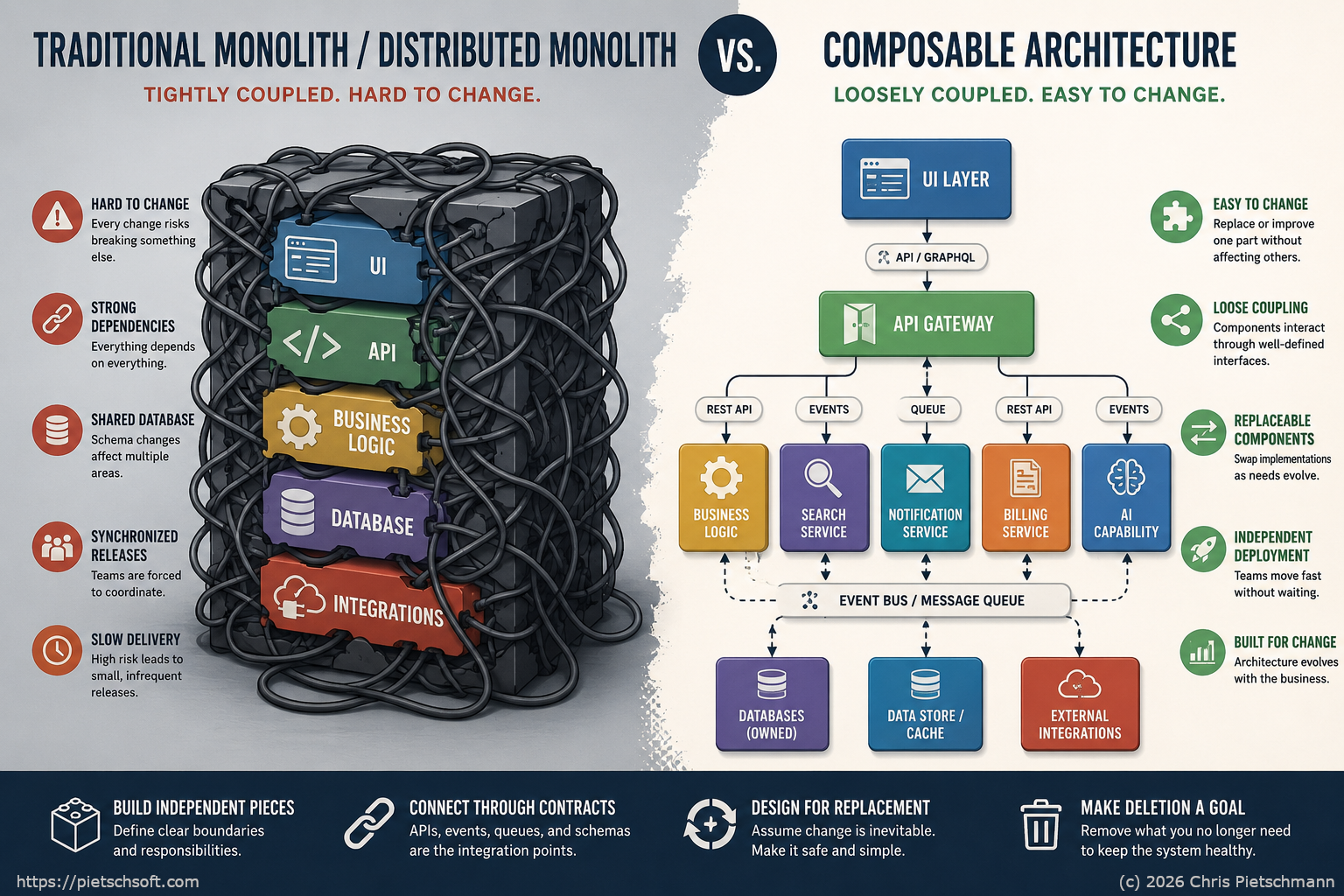
First, there was the big monolithic application. Everything lived in one codebase. The UI, business logic, data access, reporting, background jobs, integrations, and sometimes even deployment scripts were packed together. This made development simple early on, but over time the system became increasingly difficult to change.
Then came the microservices movement. The promise was compelling: independent deployment, independent scaling, team autonomy, technology flexibility, and smaller units of change.
But many organizations did not actually build independent services. They built distributed monoliths.
A distributed monolith has the operational complexity of microservices without the architectural independence. Services are separated physically, but still coupled logically. They depend on each other’s database schemas. They require synchronized deployments. They call each other in long chains. They share internal models. A change in one service breaks three others. Nobody owns the full workflow, and every release becomes a coordination exercise.
That is not loose coupling. That is a monolith spread across the network.
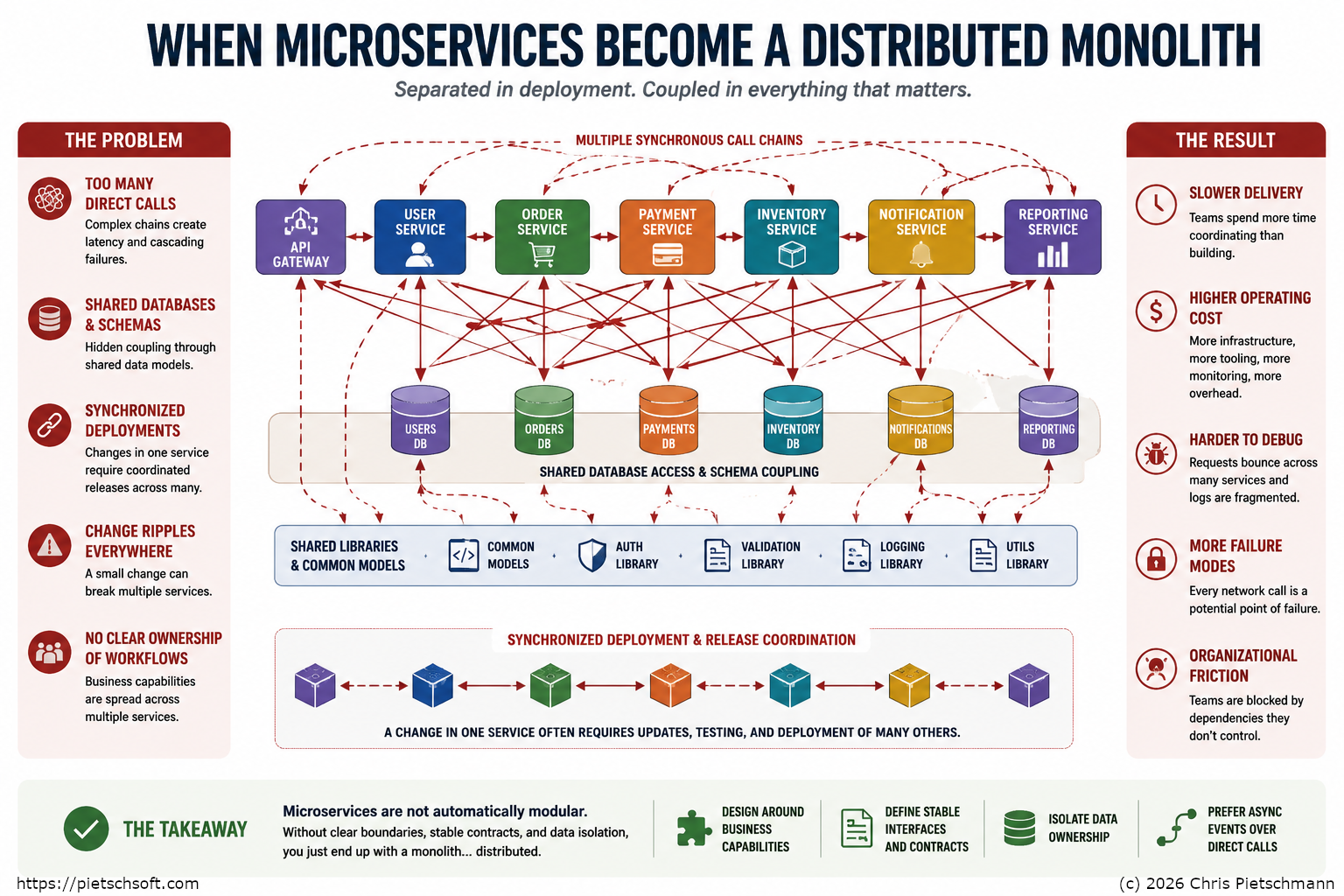
In many cases, microservices made the architecture harder to understand, harder to test, harder to debug, harder to secure, and harder to operate. The organization gained more repositories, more deployment pipelines, more logs, more alerts, more latency, more failure modes, and more governance overhead, but did not gain the ability to move faster.
This is the key tension: architecture patterns are often adopted for their promised benefits, not their actual tradeoffs.
A monolith is not automatically bad. A microservices architecture is not automatically good. A modular monolith can be excellent when the internal boundaries are clear. A microservices architecture can be excellent when the services are truly independent and aligned with business capabilities. A serverless architecture can be powerful when functions are cohesive and event boundaries are clean.
The problem is not the label.
The problem is coupling.
Tight coupling is the silent killer of software systems. It hides inside shared databases, shared libraries, shared deployment processes, shared domain models, synchronous service chains, undocumented assumptions, and user interfaces that know too much about backend implementation details.
A tightly coupled system eventually becomes difficult to modify because every change has side effects. Teams slow down not because they lack talent, but because the system punishes movement. Product leaders see longer delivery cycles. Business leaders see rising maintenance costs. Engineering leaders see teams spending more time coordinating than building.
This is where architecture becomes a strategic issue, not just a technical one.
When a company cannot replace a billing provider, modernize a customer portal, refactor pricing logic, migrate a database, or add AI-driven capabilities without massive disruption, the architecture has become a business constraint.
The pace of business change is only increasing. AI capabilities are being embedded into workflows. Cloud platforms are evolving. Security and compliance expectations are rising. Customer experiences need to change faster. Vendor ecosystems are shifting. Data strategies are becoming more real-time and distributed.
In that environment, rigid architecture is not just inconvenient. It is expensive.
The biggest mistake is assuming the goal is to design the perfect system.
It is not.
The goal is to design a system that can evolve when today’s “perfect” decisions become tomorrow’s constraints.
Insights and Analysis
Composable and disposable architecture begins with a simple principle: every meaningful part of a system should have a boundary.
That boundary does not always need to be a separate service. It does not always need its own repository. It does not always need its own database. It does not always need to be independently deployed.
But it does need to be conceptually separate.
This is where many teams misunderstand architecture. They think the physical structure is the architecture. They assume that splitting code into services automatically creates modularity, or that putting everything in one codebase automatically prevents it.
Neither is true.
A well-structured modular monolith can be more composable than a poorly designed microservices system. A small set of cohesive services can be more maintainable than dozens of fragmented ones. A monolith with clean internal boundaries may be easier to evolve than a distributed system full of chatty dependencies.
The architecture is not defined by how many deployable units exist. It is defined by how change flows through the system.
When one change requires updates across five services, three databases, two UI layers, and a shared library, the system is telling you something. The boundaries are wrong.
A better model is to think in terms of replaceable capabilities.
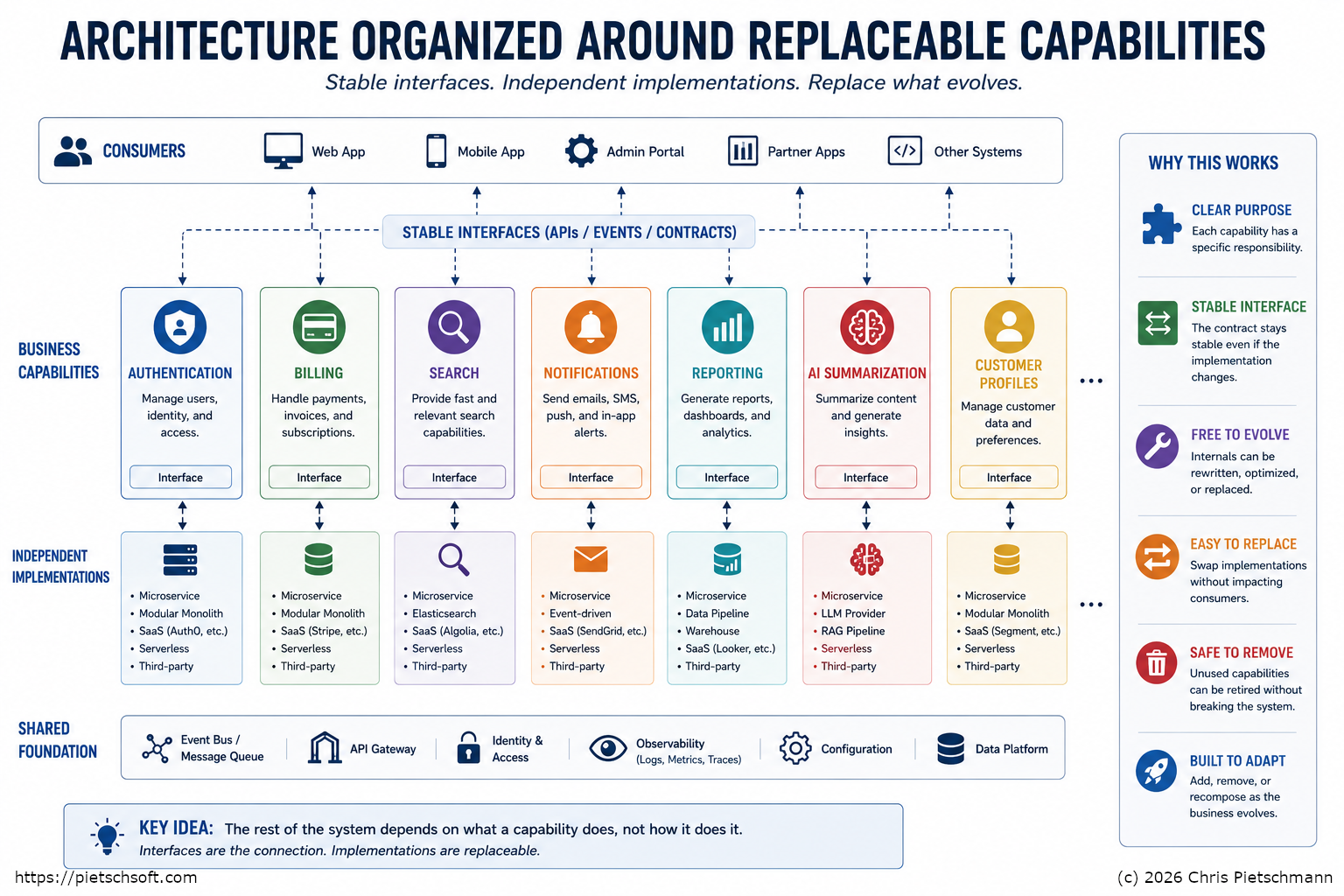
A capability is a meaningful business or technical function. Authentication. Billing. Product catalog. Search. Notification delivery. Workflow orchestration. Reporting. AI summarization. Customer profile management. Inventory availability. Pricing rules.
Each capability should expose an interface that allows the rest of the system to use it without knowing too much about how it works internally.
That interface might be a REST API, a GraphQL schema, a message contract, a command handler, a domain interface, a package boundary, or an internal module boundary. The specific mechanism matters less than the architectural discipline behind it.
The consumer should not need to know the internals. The provider should be free to evolve. The contract should be stable, versioned when necessary, and designed around behavior rather than implementation.
This is where the Lego analogy works well.
The magic of Lego is not that every piece does everything. It is that each piece can be combined with other pieces through a consistent connection model. You can replace a red brick with a blue brick of the same shape. You can remove a section and rebuild it. You can extend the structure without melting all the plastic together.
Too many software systems are built like the pieces were glued together after the first release.
They still look modular from the outside, but they cannot be separated without breaking the whole structure.
Composable architecture avoids the glue.
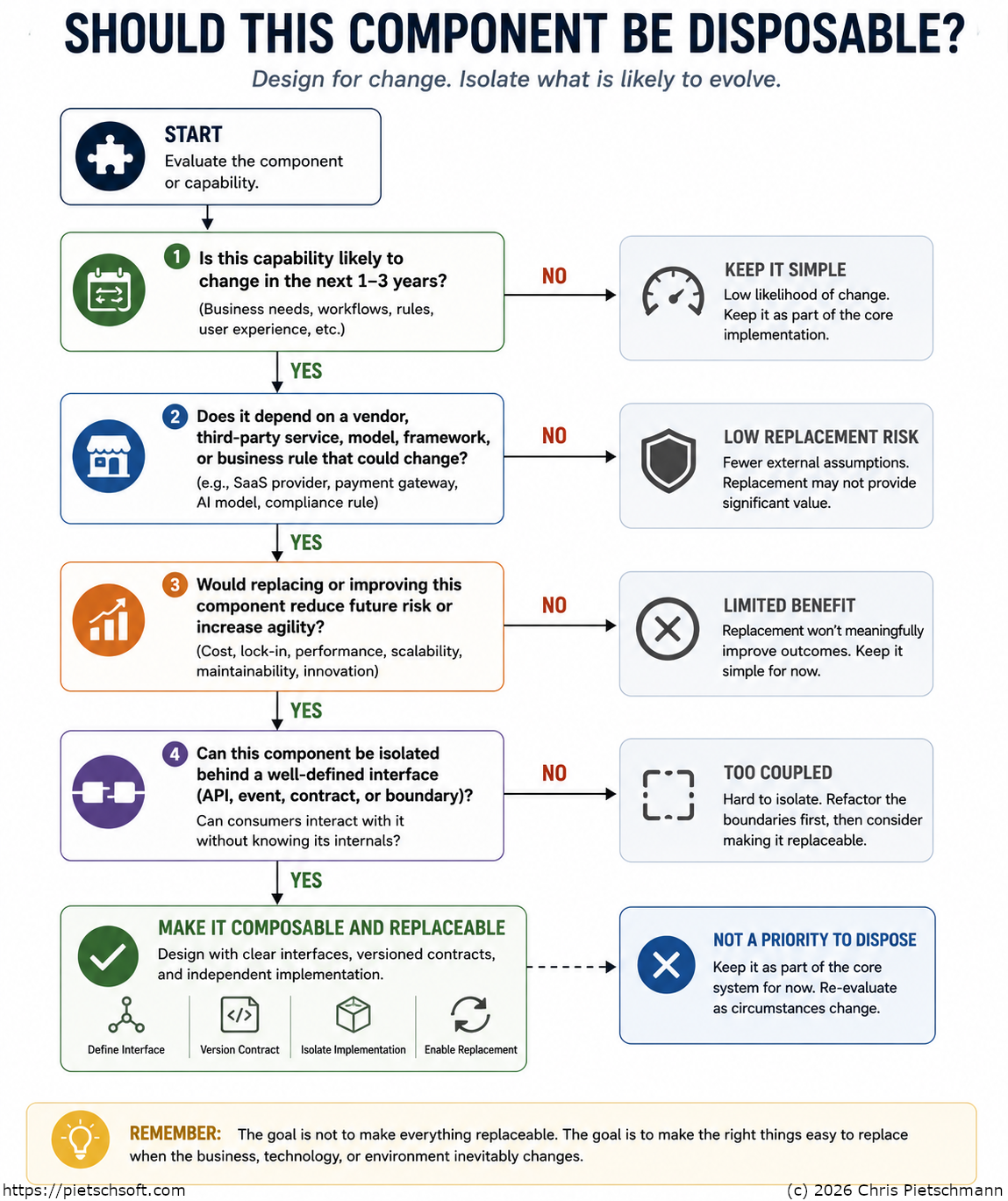
Disposable architecture goes further and asks: what would it take to replace this piece?
That question changes design decisions.
If the UI needed to be replaced, could we keep the APIs intact?
If the database needed to change, could we isolate the migration behind a data access layer or service boundary?
If the business rules needed to be rewritten, could we refactor the domain logic without changing the presentation layer?
If a vendor integration became too expensive, could we swap providers behind a stable interface?
If an AI model or agent workflow needed to change, could we replace it without rewriting the entire product experience?
If a microservice became unnecessary, could we remove it without leaving behind a trail of broken dependencies?
These questions are not theoretical. They are exactly the kinds of changes that happen in real businesses.
Product-market fit changes. Customer expectations change. Regulations change. Vendors change. Cloud costs change. Security requirements change. AI capabilities change. Data volume changes. Team structure changes.
Architecture has to assume motion.
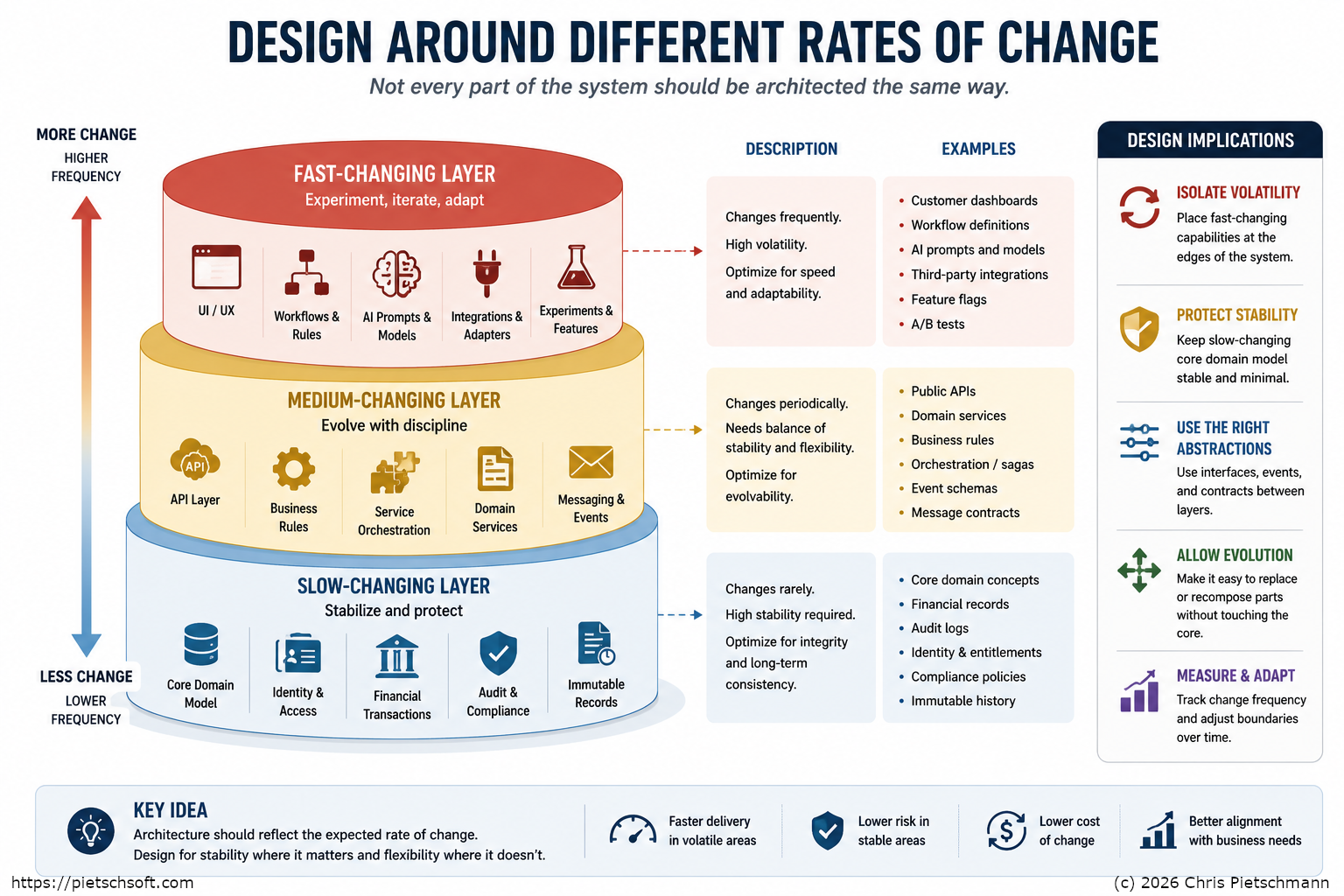
One practical way to apply this thinking is to separate systems into layers of volatility.
Some things change frequently. User interfaces, workflow rules, customer-facing experiences, AI prompts, personalization logic, vendor integrations, reporting needs, and experimentation features tend to evolve quickly.
Some things change more slowly. Core domain concepts, identity models, financial transaction records, audit history, and compliance boundaries require more stability.
A good architecture does not treat these layers the same. It protects stable core concepts while allowing volatile areas to be replaced or recomposed.
This is especially important as AI becomes more embedded in enterprise systems.
AI features are not always deterministic. The tooling is evolving quickly. Model providers change. Costs change. Capabilities improve. Governance expectations increase. Prompt strategies, retrieval pipelines, vector stores, orchestration frameworks, and agent patterns are all moving targets.
Hard-coding AI capabilities deeply into core business systems is a recipe for future rework.
Instead, AI should often be integrated as a composable capability. The rest of the system should interact with it through a clear contract: summarize this document, classify this request, recommend next steps, generate this response, extract these fields, evaluate this risk.
Behind that contract, the implementation can change. Today it might call one model provider. Tomorrow it might use a different model, a local model, a retrieval-augmented pipeline, a multi-agent workflow, or a traditional rules engine for certain scenarios.
The interface is the asset. The implementation is replaceable.
The same thinking applies to cloud architecture.
A cloud-native system should not mean a system that is permanently trapped inside one platform’s assumptions. Cloud services are powerful, and using managed services is often the right decision. But when every part of the application is directly coupled to a specific vendor’s SDK, event model, database behavior, identity system, and deployment pipeline, the organization loses flexibility.
Abstraction should not be overdone. There is such a thing as unnecessary indirection. But strategic abstraction at the right boundaries can preserve optionality.
This is where architecture becomes a business strategy.
Composable and disposable systems give organizations options. They reduce the cost of change. They make modernization incremental instead of catastrophic. They allow teams to improve parts of the system without waiting for a once-in-a-decade rewrite.
The traditional rewrite is one of the most dangerous patterns in enterprise technology. Everyone knows the current system is painful, so the organization funds a replacement. A team spends years trying to rebuild everything. Meanwhile, the business keeps changing, the old system keeps growing, and the new system is outdated before it fully launches.
Composable architecture offers a better path.
Instead of rewriting the whole house, replace the plumbing in one section. Upgrade the electrical system in another. Remodel the kitchen without demolishing the foundation. Build a new entryway while the rest of the house remains usable.
That is what good software modernization should look like.
The challenge is that this requires discipline. Interfaces need ownership. Contracts need versioning. Events need governance. Teams need to avoid leaking internal details across boundaries. Shared libraries need to be treated carefully. Database access needs to be controlled. Observability needs to span components. Testing needs to validate contracts, not just isolated units.
Composable does not mean chaotic.
In fact, composable architecture requires more intentional design than either a simple monolith or a naive microservices implementation. It requires architects and engineering leaders to think about the future cost of change, not just the immediate speed of delivery.
There are several principles I would consider foundational.
-
Design around business capabilities, not technical layers alone. A system divided only into UI, API, business logic, and database may still be tightly coupled if every feature cuts vertically through all layers with no clean boundary. At the same time, a “vertical slice” should not become a miniature monolith where the UI, API, logic, and data are inseparable. The right model is a composition of pieces that collaborate through contracts.
-
eparate interface from implementation. The rest of the system should depend on what a component does, not how it does it. This makes replacement possible.
-
Avoid shared databases as integration mechanisms. A database is not an API. When multiple components directly read and write the same tables, the schema becomes a hidden contract that is hard to version and dangerous to change.
-
Use asynchronous messaging where it reduces coupling. Message queues and event-driven architecture can help components communicate without direct dependency, but only if events are designed thoughtfully. Poorly designed events can become another form of tight coupling.
-
Version everything that matters. APIs, event schemas, data contracts, and integration payloads need versioning strategies. If the interface is the connection point, then breaking the interface breaks the architecture.
-
Optimize for replaceability, not theoretical purity. The goal is not to abstract every line of code. The goal is to identify the parts of the system most likely to change and make those parts easier to replace.
-
Make deletion a design goal. A healthy architecture should allow code to be removed. If nothing can be deleted safely, the system will only grow more complex.
That last point is underrated.
We often measure software progress by how much we add. New features. New services. New integrations. New dashboards. New pipelines. New components.
But long-term maintainability depends just as much on our ability to remove things.
Disposable software gives teams permission to retire components when they no longer serve the business. That is how systems stay healthy. Not by preserving every decision forever, but by making it safe to evolve.
Conclusion
The future of software architecture is not simply monolith versus microservices. That debate is too narrow.
The real question is whether the system can change.
A monolith with clean boundaries may be a better choice than microservices with deep coupling. A microservices architecture can be powerful when services are truly independent and communicate through stable contracts. A modular monolith can be an excellent starting point when teams need simplicity without sacrificing future flexibility. Event-driven architecture, APIs, queues, and service boundaries can all help, but only when they are used to reduce coupling rather than disguise it.
The architectural goal should be composability and disposability.
Composable software allows systems to be assembled from well-defined pieces. Disposable software allows those pieces to be replaced, rewritten, or removed when the business no longer needs them in their current form.
Together, these ideas create systems that are easier to modernize, easier to scale, easier to govern, and easier to align with business strategy.
This mindset matters more now than ever. AI is changing how systems are built and extended. Cloud platforms continue to evolve. Product cycles are accelerating. Organizations need technology stacks that can adapt without requiring constant large-scale rewrites.
The biggest architecture mistake is not choosing the wrong framework, language, or cloud service.
The biggest mistake is building systems that cannot be changed.
Software should not be treated like a monument. It should be treated like a living system made of parts: some durable, some temporary, all intentionally connected.
Build the pieces well. Define the interfaces clearly. Keep the coupling loose. Make replacement possible.
That is how we build software that can survive the future.