AI can make implementation dramatically faster. It cannot make the engineering trade-offs for us.
The future of software engineering will not be defined by how quickly we write code, but by how intelligently we design, evaluate, and evolve the systems that code creates.
The Software Engineering Profession Is at an Inflection Point
AI is fundamentally changing how software is developed. Tools such as Claude Code, GitHub Copilot, and other coding agents can generate functional code, implement features, refactor applications, create tests, and help explore system designs in minutes rather than days.
That is a real opportunity to remove repetitive work, shorten feedback loops, and get useful software in front of people sooner. It also raises an important question: as the mechanical work of writing code becomes cheaper, where does human engineering expertise create the greatest value?
I believe the answer lies in an area that has always differentiated competent programmers from exceptional software engineers: the ability to design, architect, and evolve reliable, scalable, maintainable enterprise software systems.
And this shift has particularly important implications for junior and entry-level developers entering the profession.
The Difference Between Writing Code and Engineering Software
For decades, much of the early career development of software engineers has focused on mastering programming languages, frameworks, algorithms, data structures, and development tools.
These remain essential foundations.
However, software engineering has never been simply about translating requirements into executable instructions.
Writing functional code is only one dimension of building successful software.
Engineering enterprise-grade systems requires a much broader understanding of architectural principles, system constraints, operational requirements, and the long-term consequences of technical decisions.
Consider a relatively straightforward business requirement: develop an application that processes customer orders.
An AI coding assistant can generate REST APIs, database models, authentication mechanisms, business logic, and user interfaces to implement this functionality.
The application may compile successfully, pass its unit tests, and behave exactly as expected during a demonstration.
But does that mean the application is ready for enterprise production?
Not necessarily. Before calling it production-ready, an engineering team needs to answer questions such as:
- What happens when the application must process thousands of transactions per second?
- How does it behave when a downstream dependency becomes unavailable?
- What mechanisms prevent duplicate order processing?
- How does the system maintain data consistency across distributed services?
- Can it scale horizontally without introducing transaction integrity problems?
- How will engineers diagnose production failures, deploy changes safely, or accommodate evolving business requirements?
These questions represent the difference between simply implementing functionality and engineering a production-ready software system.
AI can generate code that satisfies functional requirements without necessarily addressing the nonfunctional requirements that determine whether a system will succeed in production.
This distinction is becoming increasingly important as AI makes generating working software faster and more accessible. As I wrote in Software is Written for People, the point of software is the people who depend on it—not the volume of code used to produce it. Production engineering has to protect that value over time.
The Paradox of AI’s Expansive Knowledge
Modern AI models have been trained on enormous collections of software implementations, documentation, programming patterns, architectural discussions, and technical knowledge.
This gives them remarkable breadth.
They can generate code using a wide range of programming languages, frameworks, architectural styles, and development practices.
However, that breadth introduces an important challenge.
AI models learn from examples that reflect varying levels of engineering quality. Their training data includes well-designed systems, outdated approaches, simplistic tutorials, experimental implementations, and patterns that may be unsuitable for modern enterprise environments.
Consequently, an AI-generated solution is not automatically the most appropriate solution for a particular business or technical context.
A coding assistant may recommend a synchronous architecture where asynchronous messaging would provide better resilience.
It may introduce unnecessary dependencies, overlook transaction boundaries, create inefficient database access patterns, or generate implementations that become difficult to maintain as requirements evolve.
It may produce a technically correct solution while missing critical performance, security, or scalability considerations.
None of this means AI is incapable of sophisticated engineering. Given clear architectural requirements, constraints, and technical guidance, it can produce remarkably capable solutions.
The limitation is context. A model does not automatically know which trade-offs matter most to a particular business, team, or operating environment. That knowledge comes from people who understand the system, its users, and the consequences of failure.
The quality of AI-assisted development therefore depends not only on the model, but also on the engineering expertise directing and evaluating its work.
A Working System Is Not Necessarily a Well-Architected System
One of the more concerning trends I have observed in AI-assisted software development is the growing tendency to equate functional completeness with engineering quality.
I have seen experienced senior engineers and software architects use AI to accelerate the design and implementation of fully functional systems, only to discover that important enterprise architectural considerations were insufficiently addressed.
In particular, performance, scalability, and long-term maintainability can receive far less attention than they deserve.
It is easy to see why this happens. AI tools make it possible to move from an idea to services, APIs, integration components, database structures, and automated tests in a remarkably short time. That visible progress is valuable, but it can also create a false sense of architectural maturity.
A system that works under limited testing conditions may still fail under real-world enterprise workloads.
Database contention, inefficient service interactions, uncontrolled resource consumption, insufficient observability, poorly designed integration boundaries, and inadequate failure recovery mechanisms often become visible only when systems operate under production conditions.
These problems are not new.
Software engineers have been dealing with them for decades.
What has changed is the speed at which AI can generate implementations that contain them.
AI has dramatically accelerated our ability to create software. It has not eliminated the consequences of poor engineering decisions.
In some cases, AI can allow teams to accumulate technical debt faster than ever before.
This makes architectural discipline and rigorous engineering practices more important, not less. It also reinforces the point behind AI Doesn’t Make Great Developers. It Amplifies The Skills You Already Have.: a tool can amplify experience and judgment, but it cannot replace either.
Clean Code and Test-Driven Development Are More Relevant Than Ever
As AI assumes a larger role in code generation, some developers may conclude that traditional software craftsmanship practices are becoming less important.
I believe the opposite is true.
Clean Code principles, Test-Driven Development (TDD), SOLID principles, separation of concerns, dependency management, and disciplined refactoring remain essential foundations of sustainable software engineering.
In an AI-assisted development environment, these principles provide the guardrails that help prevent rapid code generation from becoming uncontrolled software complexity.
An engineer who understands Clean Code can recognize when AI generates overly complicated methods, tightly coupled components, misleading abstractions, or difficult-to-maintain implementations.
An engineer who understands TDD can guide AI to establish meaningful tests before implementing functionality, helping ensure that code satisfies clearly defined expectations.
Maintainability remains a first-class requirement. It is not enough for software to work, scale, and provide a usable experience today. The system also needs to be understandable, testable, and safe to change as requirements evolve. TDD and other proven system-design practices matter just as much when AI generates the implementation as they did when humans wrote and maintained every line by hand.
We cannot dismiss poor structure with the assumption that “AI will figure it out” later. AI tools also need clear boundaries, coherent abstractions, reliable tests, and consistent patterns to reason effectively about a codebase. A well-designed implementation gives both human engineers and AI assistants better context for diagnosing problems, evaluating consequences, and making future changes without breaking existing behavior.
The better the design and implementation, the better both humans and AI will be at maintaining the system.
However, even these practices must be applied intelligently.
A comprehensive suite of passing unit tests does not prove that a distributed system is resilient.
Clean, readable code does not guarantee that a database access strategy will scale.
Well-structured classes do not automatically translate into effective service boundaries.
This is why engineers must understand software quality at multiple levels.
Quality has to be evaluated at several levels:
- Code: clarity, correctness, testability, and maintainability.
- Application: sound component design, separation of responsibilities, and effective dependency management.
- System: performance, scalability, resilience, security, observability, and operational reliability.
Clean Code and TDD help us build software correctly. Architecture helps us ensure that we are building the right kind of system for its intended environment.
The strongest software engineers understand how these disciplines work together.
Enterprise Architecture Is Becoming a Critical Engineering Skill
For junior developers and engineers entering the profession, I believe this transformation should influence how they approach their professional development.
Learning how to program remains necessary, but it is no longer sufficient as a long-term differentiation strategy.
The ability to manually produce application code will become less distinctive as AI development tools continue improving.
What will become increasingly valuable is the ability to understand the architectural implications of that code.
Young engineers should begin developing foundational knowledge of enterprise software design much earlier in their careers.
This includes understanding architectural patterns such as layered architecture, hexagonal architecture, event-driven architecture, microservices, and modular monolithic systems.
It also requires learning when these patterns are appropriate—and when they introduce unnecessary complexity.
Microservices, for example, are not automatically superior to a well-designed modular monolith.
An event-driven architecture is not always preferable to synchronous communication.
Introducing distributed infrastructure does not inherently make an application more scalable.
Every architectural decision introduces trade-offs.
And understanding those trade-offs is one of the most important skills an engineer can develop.
Similarly, engineers should invest time in learning distributed systems fundamentals, including concurrency, consistency models, transaction management, message delivery guarantees, caching strategies, fault tolerance, and eventual consistency.
They should understand how systems behave under load, how bottlenecks emerge, and how different components interact across network and infrastructure boundaries.
They should become comfortable with concepts such as observability, performance engineering, threat modeling, API design, data architecture, and cloud-native application patterns.
This does not mean entry-level engineers must become enterprise architects before writing their first production application.
Architecture expertise develops through experience, experimentation, mentorship, and exposure to real-world systems.
But developing architectural awareness early creates a foundation for better engineering decisions throughout a career.
The goal is not to turn every junior developer into an architect. It is to develop engineers who understand the consequences of the software they create.
Prompt Engineering Is Useful. Engineering Judgment Is Essential.
Much of the current discussion around AI-assisted development emphasizes prompt engineering.
Certainly, the ability to communicate effectively with AI tools is important.
A well-crafted prompt can significantly improve the quality, relevance, and completeness of generated code.
But I would argue that the deeper differentiator is not prompt engineering itself.
It is the engineering knowledge behind the prompt.
Consider two developers working with the same AI coding assistant.
The first asks:
“Create an order processing service using Java and Spring Boot.”
The second specifies that the service must support high transaction volumes, handle downstream failures gracefully, enforce idempotent order processing, provide distributed tracing, maintain appropriate transaction boundaries, and expose operational health metrics.
The second developer may also require the AI to evaluate alternative architectural approaches and explain their respective trade-offs before generating code.
Both developers are using the same AI model.
But the second developer is much more likely to obtain a solution aligned with enterprise requirements.
Why?
Because the second developer understands the engineering considerations that must guide the implementation.
The real advantage is not knowing how to ask AI to write code. It is knowing what engineering requirements and constraints AI must satisfy.
There is another equally important dimension: validation. An experienced engineer does not accept an AI-generated design merely because it sounds sophisticated. They:
- challenge assumptions and examine dependencies;
- question performance characteristics and failure scenarios;
- identify unnecessary complexity; and
- request evidence through testing, benchmarking, profiling, and architectural analysis.
This ability to critically evaluate generated solutions—and to recognize when an elegant-looking design creates unacceptable operational risk—will become a defining characteristic of effective software engineers.
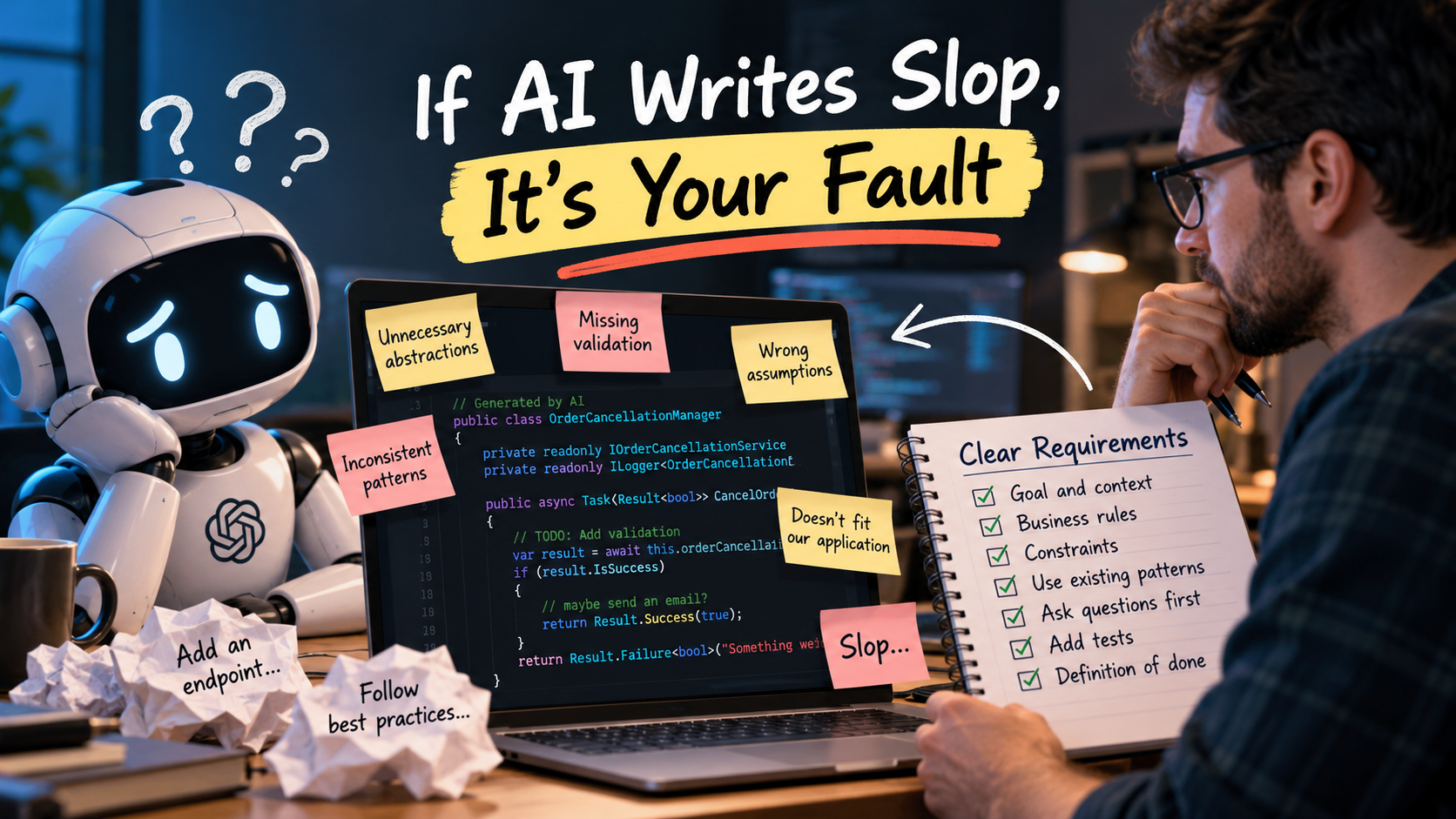
We should think of AI as a powerful engineering collaborator, not an unquestionable architectural authority. Better prompts and repository instructions help, but they are not a substitute for requirements, validation, or review. I covered that practical distinction in If AI Writes Slop, It’s Your Fault.
The Emerging Risk of Accelerated Technical Debt
One of the greatest enterprise risks associated with AI-generated software is not that AI will produce code that fails immediately.
It is that AI will produce large amounts of code that appears correct, gets deployed successfully, and gradually introduces architectural weaknesses that become expensive to correct.
Historically, the time required to implement software created a natural constraint on the volume of changes teams could introduce.
AI is weakening that constraint.
Development teams can now generate functionality, dependencies, integrations, and infrastructure definitions much faster than traditional development processes allowed.
But the organizational capacity to review, understand, test, secure, and operate that software may not improve at the same rate.
This creates an imbalance.
The volume of generated software can increase faster than an organization’s ability to maintain architectural integrity.
Without appropriate engineering governance, this imbalance can lead to fragmented architectures, inconsistent design patterns, duplicated capabilities, excessive dependencies, and growing maintenance burdens.
Organizations must therefore rethink how they integrate AI into their engineering practices.
Architectural standards, automated quality gates, performance testing, security validation, architecture decision records, code review, and production observability become essential components of responsible AI-assisted development.
Importantly, these practices should not be treated as bureaucratic obstacles to development speed.
They are mechanisms for preserving the long-term benefits of that speed.
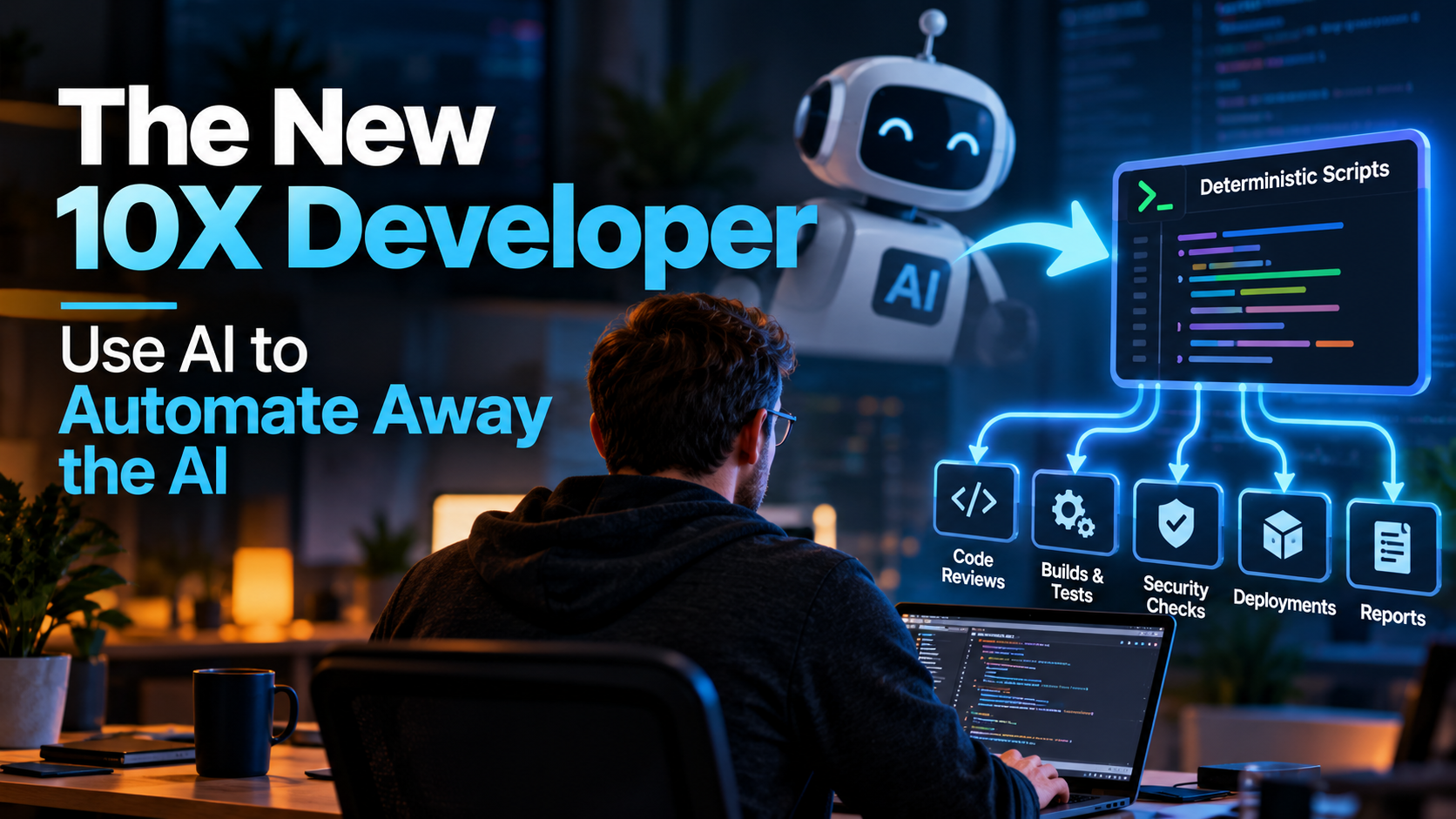
AI can also help enforce these standards by reviewing code against documented architecture, identifying deviations, suggesting improvements, and supporting automated verification.
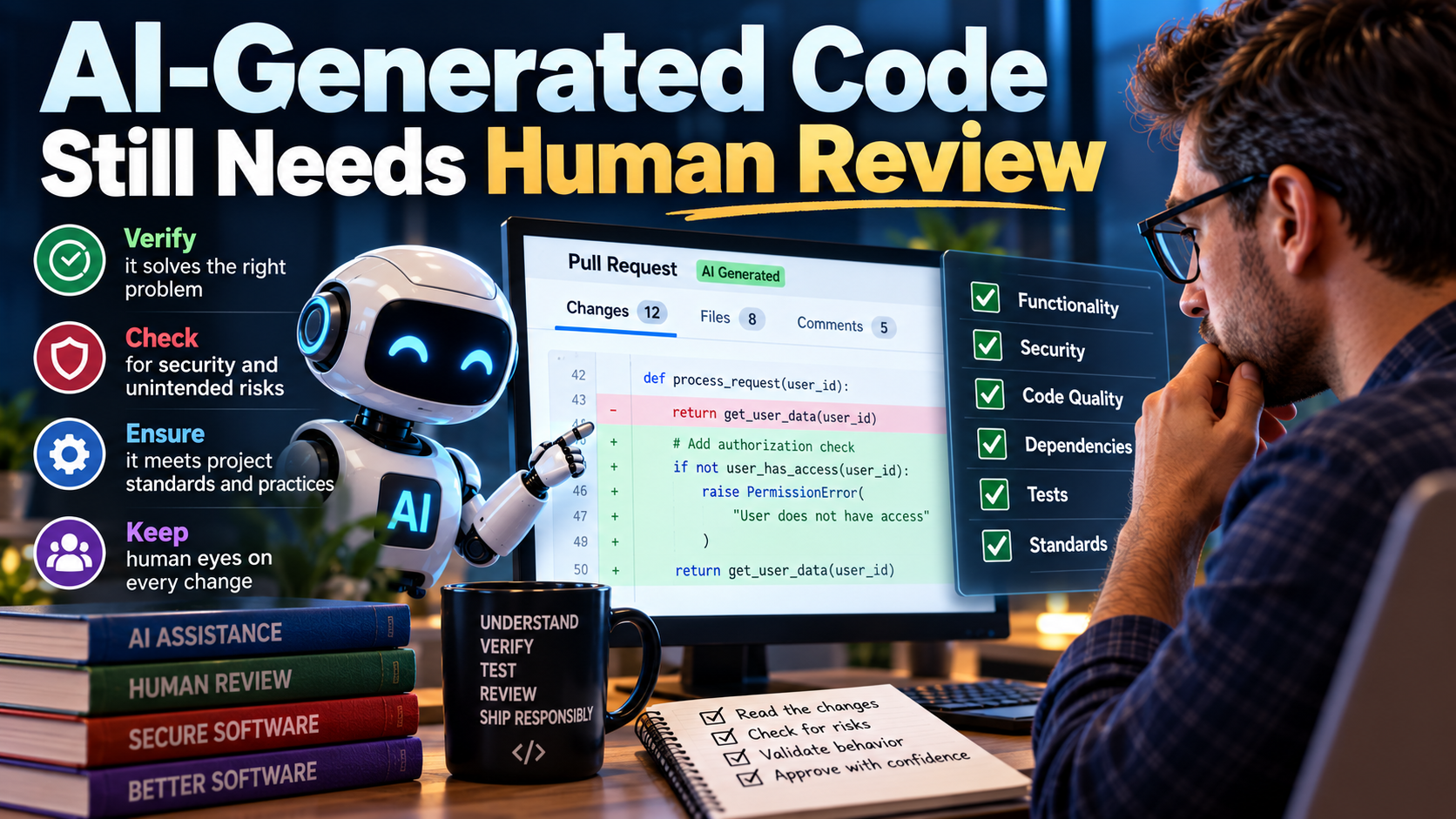
In other words, the same technology that accelerates software creation can also strengthen engineering quality—provided organizations intentionally design their development processes around that objective. That means treating AI output as a proposed change to evaluate, not as an authority to approve on its own.
Software Engineering Education Must Evolve
This transformation has implications beyond individual career development.
It challenges how organizations, universities, coding boot camps, and engineering leaders prepare the next generation of software professionals.
For many years, entry-level hiring and technical education have placed significant emphasis on coding proficiency, algorithmic problem-solving, and familiarity with particular programming languages or frameworks.
These capabilities still matter.
But as AI becomes more proficient at producing implementations, engineering education must place greater emphasis on system-level reasoning.
Junior engineers need opportunities to understand why architectural patterns exist, how design decisions affect production behavior, and what distinguishes a functional prototype from an enterprise-ready solution.
This requires moving beyond exercises that focus exclusively on implementing features.
Imagine an engineering assignment where AI generates an application, and the developer’s responsibility is to evaluate its architecture.
The engineer must identify potential scalability bottlenecks, assess security risks, evaluate transaction consistency, improve observability, and explain the rationale behind proposed design changes.
Or consider a project where developers are asked to use AI to implement the same business capability using different architectural approaches.
They must compare those approaches based on performance, complexity, deployment requirements, operational cost, maintainability, and business constraints.
Such exercises develop a skill that will remain valuable regardless of how sophisticated AI coding tools become:
The ability to reason about systems rather than simply produce implementations.
Engineering leaders should also reconsider how they mentor junior developers.
If AI handles an increasing share of routine implementation work, organizations must deliberately create opportunities for less-experienced engineers to develop the judgment traditionally acquired through hands-on development, debugging, troubleshooting, and incremental exposure to complex systems.
Otherwise, we risk creating a generation of developers who can generate sophisticated applications but cannot adequately explain, diagnose, or evolve them.
That would be a significant loss for the software engineering profession.
Senior Engineers and Architects Must Adapt Too
Although the implications for junior engineers are particularly important, experienced engineers and architects are not exempt from this transformation.
In fact, AI raises the expectations placed on senior technical professionals.
It is no longer enough to possess deep architectural knowledge while remaining disconnected from modern AI-assisted development practices.
The most effective engineering leaders will combine architectural expertise with the ability to leverage AI throughout the software development lifecycle.
They will use AI to explore alternative system designs, identify potential architectural weaknesses, accelerate prototyping, generate implementation options, and automate repetitive engineering activities.
But they will also recognize the boundaries of AI-generated recommendations.
Experienced architects must remain accountable for design decisions involving security, scalability, resilience, operational complexity, regulatory constraints, and long-term technology strategy.
More importantly, they must ensure that architectural principles are translated into practical engineering standards that development teams—and their AI coding assistants—can consistently follow.
This represents an evolution in technical leadership.
Rather than focusing primarily on how teams implement individual components, engineering leaders will increasingly focus on establishing the constraints, reference architectures, quality standards, and verification mechanisms that enable AI-assisted development at enterprise scale.
The architect’s responsibility is not diminished by AI. It becomes more important as the speed and volume of software creation increase.
The Future Belongs to Engineers Who Can Think in Systems
There is a temptation to frame the future of software engineering as a competition between human developers and AI coding agents.
I believe that framing misses the more important transformation.
AI is changing the nature of engineering work.
As code generation becomes increasingly automated, engineers will have more opportunities to focus on higher-level concerns: understanding business problems, designing effective solutions, evaluating alternatives, ensuring system quality, and managing architectural complexity.
The ability to write code will remain important, particularly for understanding and validating generated implementations.
But the relative value of manually producing large amounts of routine code is likely to decline.
Meanwhile, the value of understanding complex systems, making sound technical decisions, and recognizing architectural risks will continue to grow.
This does not mean AI will never become highly capable at architecture.
In fact, AI will almost certainly become increasingly effective at evaluating designs, identifying performance problems, recommending architectural improvements, and reasoning about system-level constraints.
But even as those capabilities improve, organizations will still need engineers who understand their business context, establish engineering priorities, evaluate trade-offs, and remain accountable for the consequences of technical decisions.
Software architecture is not simply a collection of patterns that can be memorized and reproduced.
It is the discipline of balancing competing requirements under real-world constraints.
Performance versus cost.
Scalability versus simplicity.
Consistency versus availability.
Flexibility versus complexity.
Development speed versus long-term maintainability.
These decisions depend on business priorities, organizational capabilities, operating environments, and acceptable levels of risk.
There is rarely a universally correct architecture.
There is only an architecture that is more or less appropriate for a specific context.
And that is precisely why engineering judgment matters.
My Advice to the Next Generation of Software Engineers
If I were advising a junior developer entering the profession today, my recommendation would be straightforward:
Learn to code well, but do not build your entire professional identity around typing code.
- Master programming fundamentals, including the behavior of the languages and platforms you use.
- Develop disciplined habits around Clean Code, TDD, refactoring, and software craftsmanship.
- Become proficient with AI coding tools and learn to use them responsibly.
- Invest equally in how enterprise systems are designed, integrated, deployed, secured, monitored, and scaled.
Then ask questions that go beyond whether an implementation works:
- Will it continue to work under load and when components fail?
- Can it evolve as business requirements change?
- Is the architecture unnecessarily complex?
- Can another engineering team understand and maintain it?
- What risks are we introducing today that could become expensive tomorrow?
- Do we understand why this design is appropriate, or are we simply accepting what AI generated?
These questions will help distinguish engineers who merely consume AI-generated solutions from those who can genuinely direct and improve them.
The Next Competitive Advantage in Software Engineering
AI represents an extraordinary advancement in software development.
It has the potential to eliminate substantial amounts of repetitive coding work, accelerate innovation, and allow engineers to tackle problems that previously required much greater time and effort.
We should embrace these capabilities.
But we should not confuse faster software creation with better software engineering.
The ability to generate functional code is becoming increasingly accessible.
The ability to consistently design secure, scalable, resilient, maintainable enterprise systems remains a challenging discipline that demands knowledge, experience, and sound judgment.
For junior developers, this is an invitation to expand their learning beyond programming syntax and frameworks.
For senior engineers, it is a reminder that technical expertise must evolve alongside AI capabilities.
For software architects and engineering leaders, it is an opportunity to establish the engineering principles and practices that will guide an entirely new era of software development.
The engineers who thrive in this environment will not necessarily be those who can produce the most code or master the latest AI prompting techniques.
They will be those who can combine strong engineering fundamentals, architectural thinking, business understanding, and AI-assisted development into a disciplined approach to building software.
Ultimately, enterprise software success is not measured by how quickly we generate code. It is measured by how reliably the systems we build deliver value to people over time.
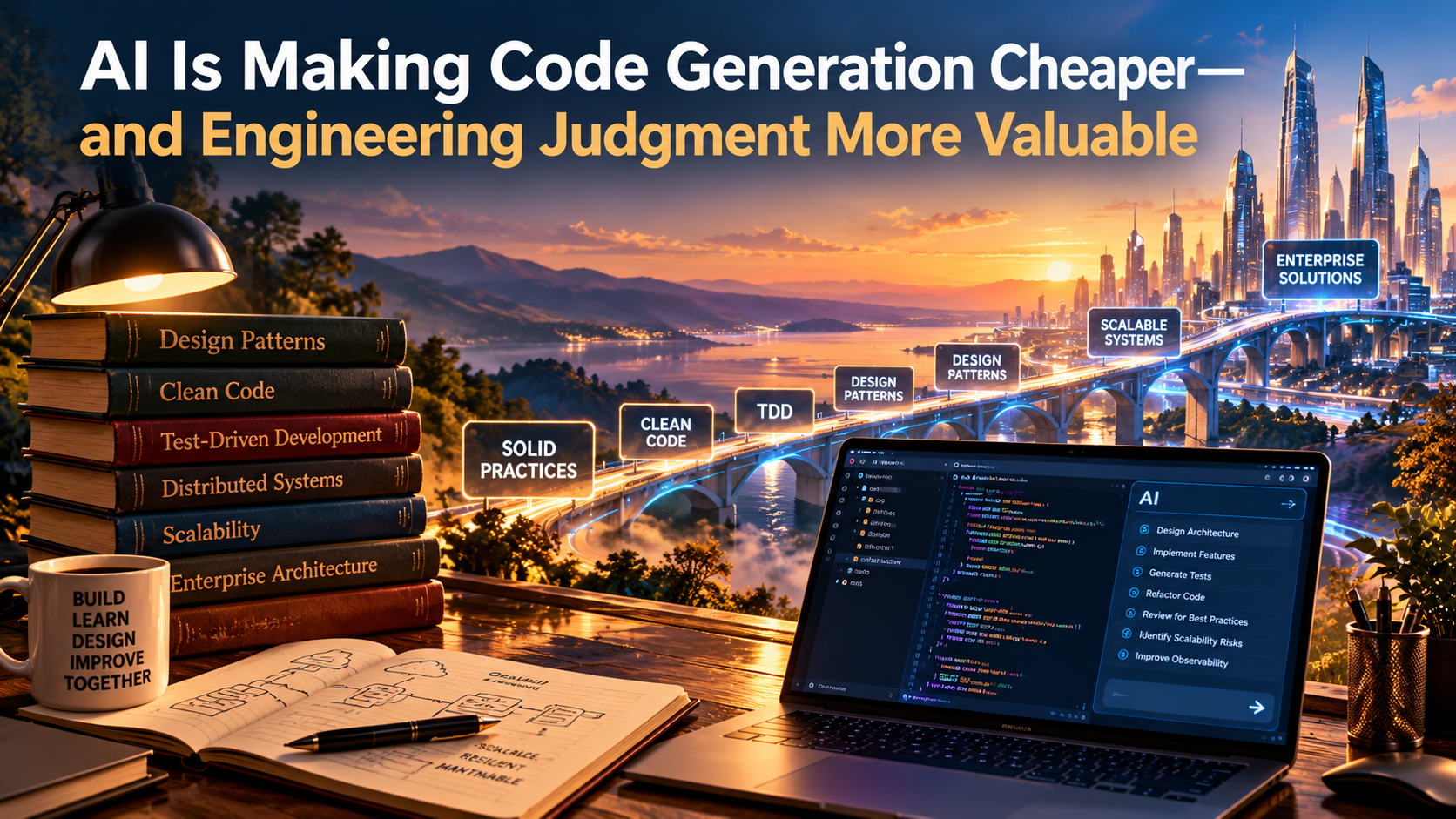
AI is making code generation cheaper. Engineering judgment is becoming more valuable. The engineers who understand that distinction—and build systems that humans and AI can safely evolve—will create the most durable value.