Why the future belongs to people who learn to use AI, not people who panic about it.
AI Is Not the Destination
When people talk about AI today, the conversation usually swings between two extremes. On one side, there is hype. On the other, there is fear. Some people talk as if AI will solve everything. Others talk as if it will replace everyone.
I do not believe either of those views is right.
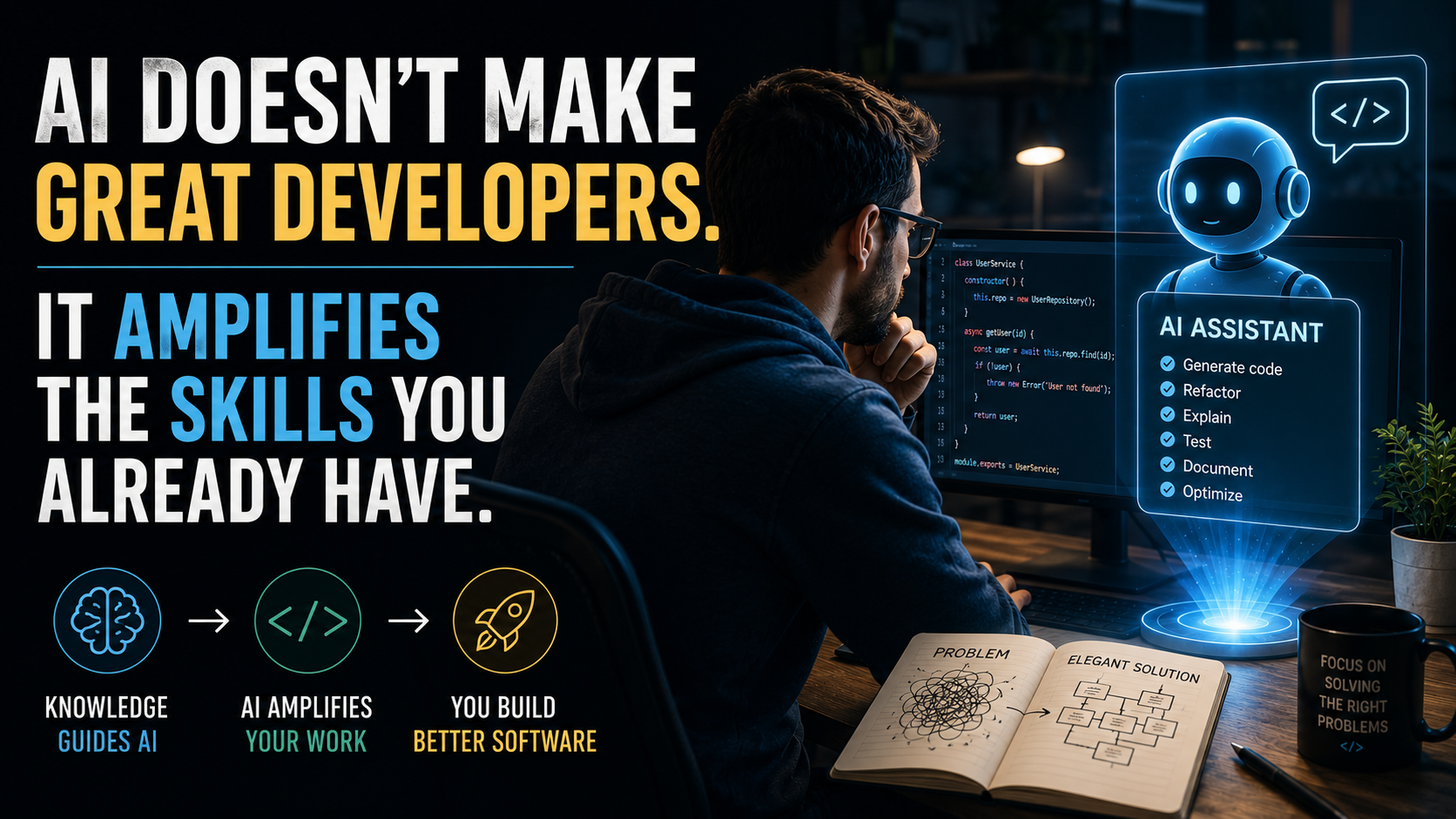
A better way to think about AI is this: AI isn’t the thing. It gets you to the thing.
Technology Is Leverage, Not Purpose
That idea is adapted from a quote in Halt and Catch Fire: “Computers aren’t the thing. They’re the thing that gets you to the thing.” The point is simple, but important. The real value is not in the technology itself. The value is in what the technology helps people do. It is in the work it enables, the problems it helps solve, the ideas it helps explore, and the value it helps create.
That is how I see AI.
AI is not the destination. It is not the product, the mission, the craft, or the purpose. It is a tool that helps you move faster toward those things. It helps you think, build, write, analyze, troubleshoot, and create with more speed and leverage than before. But the real goal is still the thing behind it: the result, the solution, the value, the outcome.
That is why I do not think AI will simply replace people in the way many fear. But I do think it will absolutely change the way people work. In fact, it already is.
And if there is one practical truth that people need to accept now, it is this: AI may not replace you, but someone using AI might.
That is not panic. That is not hype. That is just the reality of how technology changes work.
This Pattern Is Not New
We have seen this pattern before.
Computers did not eliminate work. They transformed it. Automobiles did not eliminate transportation jobs. They changed them. Automatic elevators did not end human usefulness. They removed one type of task and created new expectations for speed, scale, and efficiency elsewhere. The internet did the same. Search engines did the same. Cloud computing did the same. Smartphones did the same.
Adaptation Creates Advantage
Each time, the tools changed the workflow. They changed what was manual, what was automated, what was expected, and what skills became more valuable. People who adapted gained an advantage. People who resisted too long often found themselves overtaken by those who embraced the shift.
AI is following that same pattern, but it is happening faster than most technological shifts we have experienced before.
In my view, AI is one of the most transformative technological advancements we have seen, likely on the scale of computers or even electricity in terms of how deeply it will reshape work and society. That may sound bold, but the speed of change is what makes it hard to ignore. Innovation is happening faster. Adoption is happening faster. Expectations are changing faster. Entire workflows that seemed stable just a short time ago are already being rethought.
That speed is what makes many people uneasy.
The Question That Actually Matters
I understand that concern, especially for people in IT and other knowledge-based professions. If your work involves writing, analysis, planning, coding, troubleshooting, documentation, communication, design, or research, then AI is already touching some part of what you do. That can feel threatening if you see only the surface of it. It can feel like the machine is moving into your lane.
But that is the wrong place to focus.
The better question is not, “Can AI do part of my work?”
Of course it can.
The better question is, “How do I use AI to do better work, faster, more effectively, and with more value than I could before?”
That is the question that matters because it is the one you can actually do something about.
Focus on What You Can Control
There is a practical, almost stoic lesson in that. You cannot control that AI exists. You cannot control that companies will adopt it. You cannot control that job expectations will evolve. You cannot control that the market will reward people who know how to use these tools well.
What you can control is whether you learn. Whether you adapt. Whether you build skill. Whether you become more effective. Whether you turn AI into leverage instead of treating it only as a threat.
That is where your energy should go.
What 25+ Years in IT Has Taught Me
My own experience with AI has reinforced this view.
I have worked in IT for more than 25 years, and one thing has been true across that entire time: technologies, platforms, and tasks regularly become obsolete. That is not new. It has been normal for decades. Skills that were once essential often get replaced, abstracted, automated, or folded into something else within a few years. In many cases, what was once specialized becomes standard, and what was once valuable shifts somewhere else.
For most of my career, that cycle has often happened in roughly a two- to five-year window.
With AI, it feels more like one to three years.
The Cycle Is Accelerating
That is a major acceleration, but the pattern itself is familiar. The tools change. The work changes. The people who keep learning stay relevant.
Over the last several years, I have worked a lot with AI in different forms, from teaching classes on how to set up and use Azure Machine Learning and emphasizing how important good data is to machine learning, to using Generative AI in day-to-day work for writing documentation, drafting blog posts, generating and refining code, exploring ideas, and more. It has been a phenomenal productivity booster. It has helped me get more done and provide more value than I otherwise could have in the same amount of time.
But that does not mean AI is doing the real thinking for me.
AI as Multiplier, Not Replacement
It is not replacing the intelligence, judgment, experience, ingenuity, or innovation that the human brings to the work. It is accelerating the work around those things. It is helping with momentum. It is helping with drafts, patterns, summaries, structure, speed, and iteration. It is getting me closer to the thing.
That distinction matters.
AI can help write text faster. It can help generate code faster. It can help organize information faster. But faster is not the same as wiser. Faster is not the same as correct. Faster is not the same as original. And faster is definitely not the same as accountable.
That is where the human in the loop matters most.
Human Judgment Becomes More Valuable
The more powerful AI becomes, the more important human judgment becomes with it.
This is especially obvious when the work moves beyond common patterns and into messy reality. AI is often strongest when dealing with what has already been done many times before. It can imitate patterns, remix existing knowledge, and generate plausible outputs based on familiar structures. That is useful. Sometimes extremely useful.
But when the problem is complex, unusual, poorly documented, constrained by business realities, entangled with legacy systems, or dependent on deep context and experience, AI often starts to struggle.
Where AI Struggles in the Real World
I have seen that firsthand in legacy IBM mainframe modernization work I have been involved with more recently. These are not always neat, predictable, textbook problems. They often involve years of historical baggage, unusual constraints, hidden dependencies, and decisions that only make sense once you understand the environment, the people, and the business context surrounding them. In those situations, AI can assist, but it cannot carry the solution on its own. The real difference often comes from the experienced human in the loop who can recognize what matters, question bad assumptions, navigate ambiguity, and invent a path forward when there is no obvious pattern to copy.
Craftsmanship Still Matters
That is craftsmanship.
And that is why I do not believe AI is the end of human value. If anything, it makes human value more visible.
Not every part of work is equally valuable. Some parts are repetitive. Some parts are mechanical. Some parts are necessary but tedious. AI is very good at helping with those layers. That is a benefit, not a loss. If AI can reduce some of the grind, then more of your time can move toward the parts of the work that require taste, judgment, creativity, context, and responsibility.
Risks Are Real, and So Is the Opportunity
That said, AI does come with risks and downsides, and they should not be ignored.
AI can be confidently wrong. It can produce shallow work that sounds better than it is. It can encourage people to skip understanding and jump straight to output. It can amplify bad assumptions. It can create security, privacy, and compliance concerns if used carelessly. It can make it easier to produce more, while also making it easier to produce more noise.
Those are real problems.
Keep the Human in the Loop
But even here, the answer is not panic. It is not rejection. It is human oversight.
The risks in AI are exactly why the human in the loop becomes more important, not less. Someone still has to validate the output. Someone still has to apply judgment. Someone still has to determine whether the answer is useful, safe, accurate, original enough, and appropriate for the context. Someone still has to own the result.
That “someone” is you.
The Practical Response
So no, I do not think the right response to AI is fear. And I do not think the right response is blind optimism either.
The right response is to treat AI the same way thoughtful people have always treated major technological change: with clear eyes, practical curiosity, and a willingness to adapt.
Practice Over Panic
Learn it.
Use it.
Test it.
Challenge it.
Understand where it helps and where it fails.
Use it to become more productive, more informed, and more capable.
Do not worship it. Do not panic about it. Just put it to work.
Because that is what it is: work leverage.
The Path Forward
AI is not the thing. It gets you to the thing.
It gets you to the better draft, the quicker prototype, the first pass, the accelerated research, the improved productivity, the faster iteration, the stronger starting point. But you still have to know what matters. You still have to decide where you are going. You still have to bring the insight, the taste, the accountability, and the ingenuity that turn output into value.
That is why I believe people should stop panicking and start practicing.
The future does not belong to people who fear AI. It does not belong to people who hype it as magic either. It belongs to people who learn how to use it well.
If you embrace AI, you can gain an advantage over those who do not. If you get better with AI, you can become more effective, more productive, and more valuable. Not because the tool becomes your replacement, but because it becomes your multiplier.
That is how I see the path forward.
AI is just another tool, though a profoundly transformative one. Like every major tool before it, it changes how we work. It changes what is possible. It changes what is expected. But it does not remove the need for people. It raises the value of people who know how to use it with wisdom.
So focus less on the fear that AI is the thing.
And focus more on the thing it can help you do.