Why creating is the fastest path to confidence, growth, and real opportunity.
Consumption Feels Like Progress
We live in a time when learning has never been easier. You can watch videos, listen to podcasts, read articles, buy courses, follow experts, subscribe to newsletters, scroll through tutorials, and spend hours every day absorbing ideas from people who seem to have it all figured out.
That is not a bad thing. Learning matters. Exposure matters. Good teaching matters.
But there is a trap hidden inside all of it: consumption feels a lot like progress, even when it is not.
You can spend weeks reading about architecture patterns, cloud strategy, coding practices, startups, AI workflows, personal branding, content creation, or career growth and still not have built anything meaningful yourself. You can feel productive because your mind is busy. You can feel informed because your inputs are strong. You can feel like momentum is happening because information is constantly moving through your world.
But motion is not always momentum. And learning is not always building. At some point, that distinction becomes impossible to ignore.
The Shift That Changes Everything
There was a season in my own career when I spent more time consuming than creating. I was reading what the experts wrote. Watching what the experts made. Studying what the experts taught.
And again, there is nothing wrong with that on its own. In many ways, it helped me. It expanded my thinking. It exposed me to new tools, new ideas, and new possibilities.
But it also created a subtle illusion. It made me feel closer to mastery than I really was.
Because the truth is this: you do not become known for what you consume. You become known for what you create.
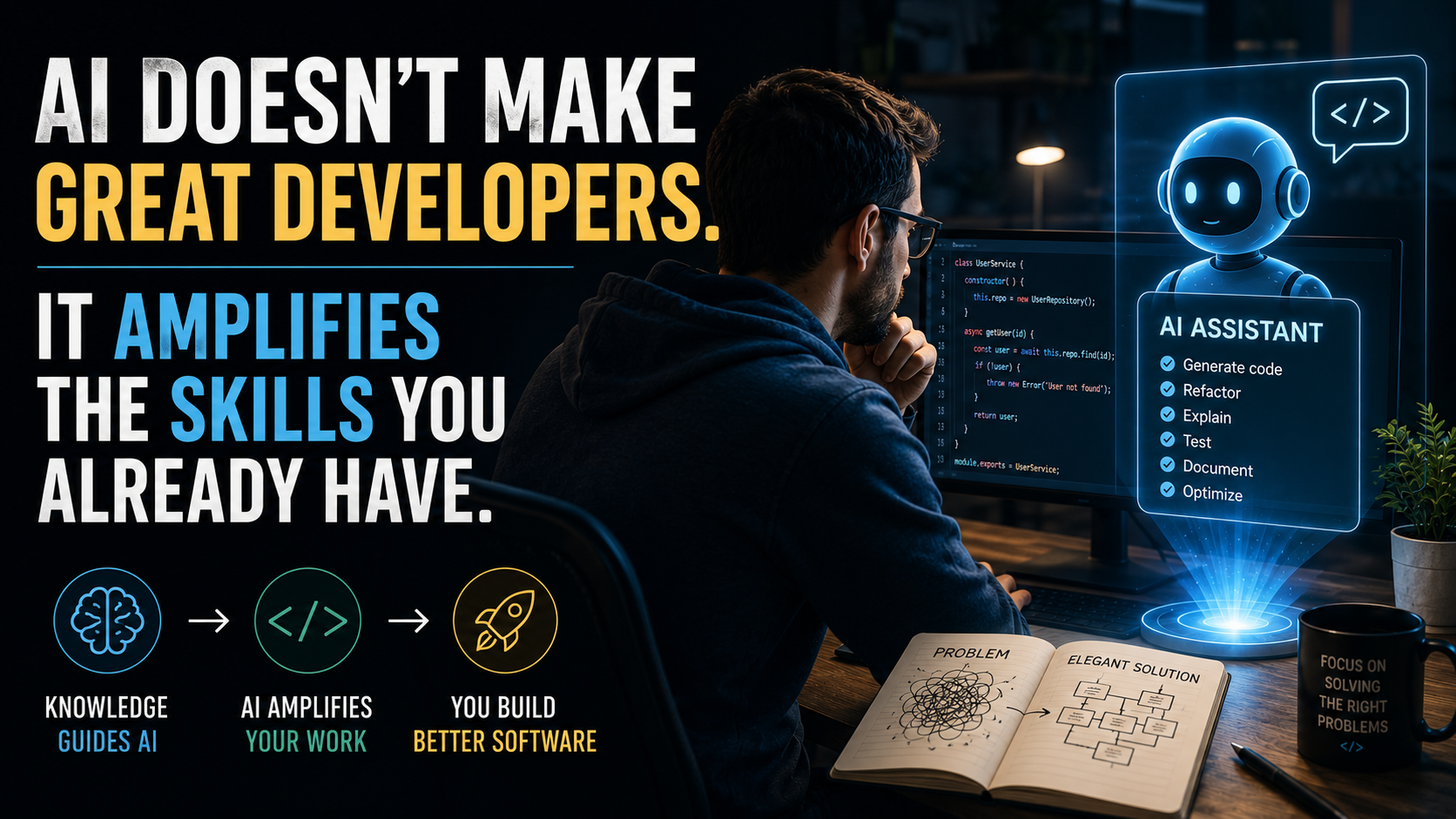
That was the shift. At some point, I stopped treating learning as the main thing and started treating it as support for the main thing. The main thing became creating. Writing, building, publishing, shipping, sharing, teaching, experimenting.
Creating became the center. Learning became the fuel. That change made a bigger difference in my life and career than almost anything else.
Learning Supports the Work
Learning is valuable. But learning is strongest when it feeds action.
A tutorial is useful if it helps you build the project. A book is useful if it sharpens your thinking enough to publish the article. A course is useful if it gets you to apply the skill.
Knowledge becomes powerful when it turns into output. That is where the real transformation happens.
Creation Makes Things Real
There is something important that happens when you create that cannot happen in quite the same way through passive learning.
Creation exposes reality. It shows you what you actually understand. It shows you where your thinking is strong and where it is still shallow. It forces you to organize ideas instead of just recognizing them. It forces you to make decisions, confront ambiguity, and solve problems that feel much cleaner in theory than they do in practice.
That is a gift. Because the gap between what sounds clear in your head and what works in the real world is exactly where growth happens.
You can read ten articles about building software, cloud architecture, infrastructure as code, AI systems, or technical leadership. But when you sit down to build something yourself, everything changes. Now you have to make tradeoffs. Now you have to decide what matters. Now you have to deal with edge cases, constraints, uncertainty, imperfect information, and the tension between “ideal” and “done.”
That is where skill gets forged.
Practice Creates Depth
This is why creation builds depth in a way that consumption alone cannot. Consumption gives you awareness. Creation gives you understanding. Consumption introduces concepts. Creation gives you scars, lessons, judgment, and experience.
And in technology especially, those things matter. Because real-world work is rarely a clean copy of the examples. The people who grow the most are usually not the ones who only study the craft from a distance. They are the ones who step into it.
Confidence Is Built, Not Waited For
A lot of people are waiting to feel ready. They want a little more certainty. A little more validation. A little more expertise. A little more confidence. Then they will start the blog. Then they will publish the project. Then they will create the course. Then they will share what they know. Then they will build in public. Then they will finally put their ideas out there.
I understand that instinct. But I think it gets people stuck for far too long.
Because confidence usually does not come before creating. Confidence comes from creating.
That is an important distinction. You do not wait until you feel like an expert and then begin. In many cases, you begin, and that is part of how expertise gets built.
You publish the first article that is not perfect. You release the first project that is smaller than you imagined. You teach the lesson you just learned. You share the idea you have been testing. You put something into the world. Then you do it again. And again. And again.
That repetition changes you. Not because every piece is extraordinary. But because the process turns hesitation into capability.
Action Reduces Imposter Syndrome
Imposter syndrome feeds on inaction. It grows in the space where ideas never meet reality.
When you are only thinking, comparing, and observing, it is easy to feel behind. It is easy to assume everyone else knows more. It is easy to look at polished outcomes and forget the messy path that produced them.
Creation interrupts that cycle. It gives you evidence. Evidence that you can think. Evidence that you can build. Evidence that you can solve problems. Evidence that you can contribute something useful.
The answer to feeling like an imposter is not always more reassurance. Often, it is more reps.
Visibility Follows Output
There is another practical reality here that matters for anyone building a career: opportunity tends to follow visible proof of work.
Not always. But often. People can only respond to what they can see. A portfolio can be seen. A blog can be seen. An open-source project can be seen. A talk can be seen. A course can be seen. A newsletter can be seen. A body of published work can be seen.
And once people can see your thinking, your skills, your consistency, and your perspective, new things start to happen. Connections happen. Trust happens. Credibility happens. Job opportunities happen. Business opportunities happen. Invitations happen. Recognition happens.
That does not mean every act of creation needs to be strategic or optimized. It does not mean you need to turn every project into a brand play.
But it does mean this: creating compounds. Over time, it becomes a body of work. And a body of work has a way of speaking for you when you are not in the room.
Your Work Introduces You
This has been true in my own experience. Creating has opened doors that consumption alone never could. Not because every project was huge. Not because every piece of writing changed everything. But because consistent creation built something larger than any one item.
It built proof. It built trust. It built momentum. It built a signal that said: this person does the work.
That matters.
The “Experts” Are Usually Just Further Down the Road
One of the biggest myths people believe is that the people they admire are fundamentally different from them. Smarter. More gifted. More certain. More naturally equipped.
Sometimes that may be true in small ways. People have different strengths, different backgrounds, different opportunities, different timing.
But I think the bigger difference is often much simpler: they create.
They create before they feel fully ready. They create when the idea is still imperfect. They create while they are still learning. They create even when there is uncertainty. Then they keep creating long enough for that effort to compound.
That is what many people are actually seeing when they look at someone they call an expert. They are seeing accumulated output. They are seeing years of iterations. They are seeing public evidence of private discipline.
That should be encouraging. Because it means the gap may not be as mysterious as it looks. It may be built, in large part, through repeated acts of creation.
Creation Is a Habit Before It Is an Identity
Nobody starts with a body of work. Nobody starts with years of consistency. Nobody starts with credibility already formed.
Those things are built one piece at a time. One post. One tool. One project. One lesson. One experiment. One article. One talk. One contribution.
Eventually, other people may call you an expert. But long before that, you were just someone who kept creating.
The Practical Response
So what should you do with this?
Keep learning, yes. But do not stop there. Turn what you learn into something.
Write about it. Build with it. Teach it. Test it. Publish it. Refine it. Share it.
Do not worry so much about whether it is big enough. Do not worry so much about whether it is polished enough. Do not worry so much about whether someone else has already said something similar.
Your voice is built by using it. Your skill is built by applying it. Your confidence is built by practicing it.
Start Smaller Than Your Fear
A lot of people get stalled because they think creating means launching something massive. It does not.
A simple blog post counts. A small app counts. A GitHub project counts. A write-up of a lesson learned counts. A practical tutorial counts. A useful script counts. A thoughtful LinkedIn post counts. A shared insight counts.
Creation does not have to begin with scale. It just has to begin.
The Path Forward
Create. Then create again. Then create some more.
That is how ideas become real. That is how skill becomes visible. That is how confidence becomes earned. That is how opportunities begin to find you.
Learning is still valuable. It always will be. But learning is not the destination. Creation is where knowledge becomes useful. Creation is where insight becomes value. Creation is where potential becomes proof.
That is why I believe more people should spend less time worrying about whether they are ready and more time building something with what they already know.
You probably know more than you think. You probably have something useful to share already. You probably do not need another round of permission before you begin.
So write the post. Publish the project. Teach the lesson. Build the thing.
Do not wait to feel like an expert. Create your way there.