For many of us, GitHub has been part of the daily development workflow for a decade or more. For a long time, it felt like one of the most reliable and stable platforms in software engineering infrastructure. It was simply there — quietly powering collaboration, pull requests, reviews, releases, and the open-source ecosystem.
But lately, something feels different.
The Acceleration Is Real
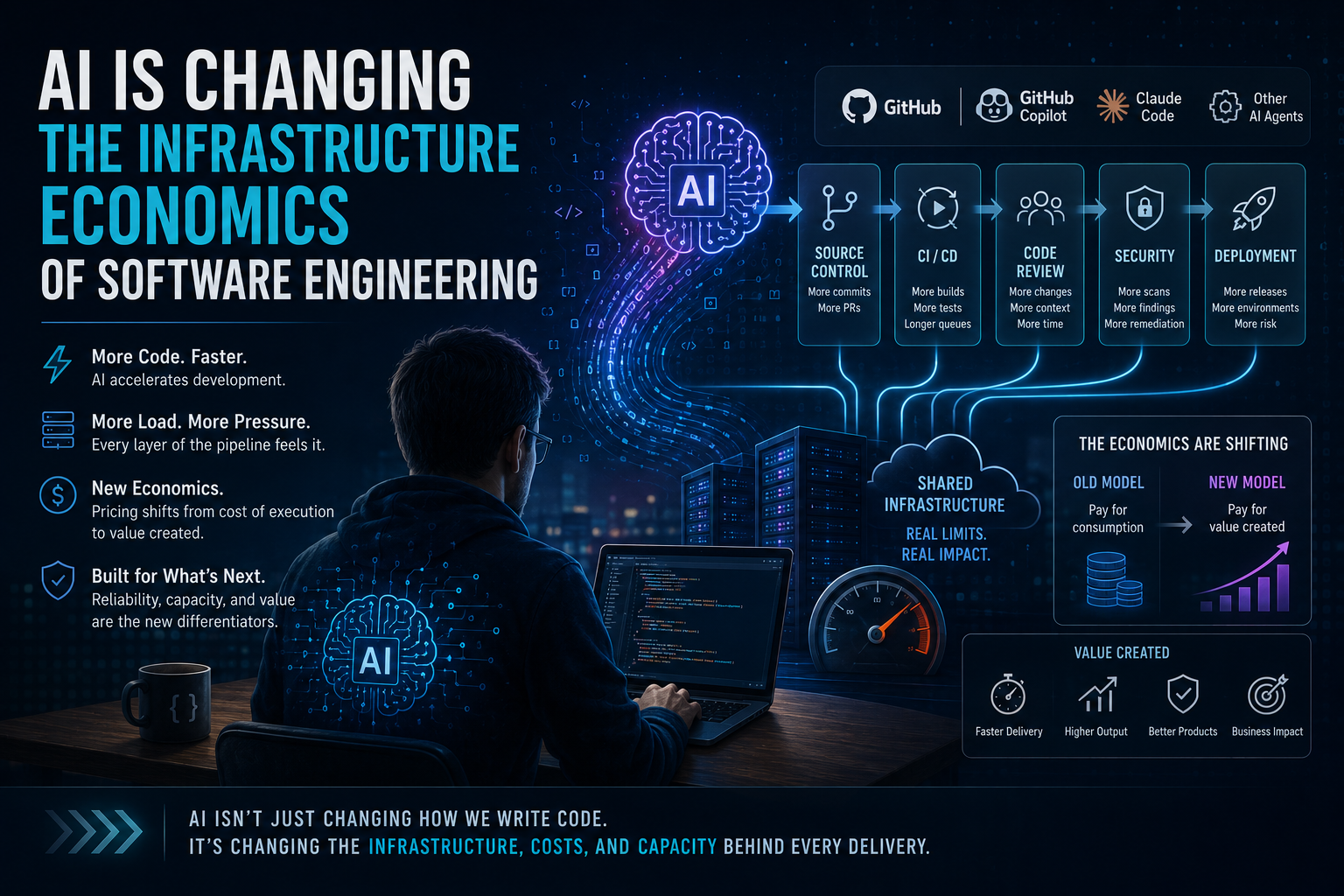
Over the last several months, developer activity appears to be accelerating significantly, driven in part by AI-assisted development tools like GitHub Copilot, Claude Code, and other coding agents. Teams are generating more code, opening more pull requests, running more checks, and moving faster than before.
That increased velocity is exciting. It is also putting real pressure on the systems that support modern software delivery.
GitHub recently shared an update on availability and the work they are doing to improve reliability. My teams and I have felt this directly over the last four to six weeks. We have run into repeated GitHub issues — some tied to visible incidents on the GitHub Status page and others that seemed smaller or less visible but still disrupted our workflows.
Pull requests stalling. Actions queuing longer than expected. Intermittent failures that do not show up on any status dashboard but still cost your team twenty minutes of confusion and context-switching. It adds up.
The Bottleneck Does Not Disappear. It Moves.
The bigger question is not just whether GitHub is having a rough stretch.
The bigger question is whether AI-assisted development is creating a new infrastructure reality.
When developers can produce more code, faster, every downstream system feels the impact:
- Source control
- CI/CD pipelines
- Code review workflows
- Security scanning
- Package management
- Deployment pipelines
- Observability and monitoring
The bottleneck does not disappear. It moves. And when it moves to shared infrastructure that millions of developers depend on, the consequences become visible quickly.
This is a pattern I have seen repeatedly across my career in architecture and SRE work. Optimizing one layer of a system does not eliminate constraints — it shifts them to the next layer that was never designed for that level of throughput. AI-assisted development is doing exactly this to the entire software delivery supply chain.
The Economics Are Shifting Too
GitHub’s recent Copilot pricing changes may be part of this broader adjustment. Higher pricing can help fund the infrastructure required to support increased demand. It may also naturally temper usage as organizations become more intentional about how and where they apply AI tooling.
But I think there is something even bigger happening.
The pricing model for developer AI is starting to move away from the cost of execution and toward the value being created.
That is an important distinction.
If AI tools are helping developers produce more output, move faster, reduce manual effort, and in some cases reshape how companies think about engineering headcount, then vendors will increasingly price these tools based on their business impact rather than their raw compute cost.
Whether you see that as good, bad, or inevitable — it feels like we are reaching an important inflection point.
Two Waves of AI Adoption
The first wave of AI adoption in software development was about experimentation and acceleration. Teams picked up Copilot, tried prompt-driven development, and celebrated the speed improvements. That wave was largely about individual productivity.
The next wave will be about:
- Capacity — Can the platforms and pipelines we depend on handle the increased volume?
- Cost — Who pays for the infrastructure strain, and how does pricing reflect value rather than consumption?
- Reliability — What happens to delivery confidence when shared systems are under sustained new pressure?
- Governance — How do organizations manage quality, security, and review at higher throughput?
- Value capture — How do vendors price tools that fundamentally change the economics of engineering teams?
This second wave is less exciting to talk about than “look how fast I can ship now.” But it is where the real structural changes will play out.
What This Means for Engineering Leaders
If you are leading a team, running infrastructure, or making platform decisions, this matters now. A few things worth thinking about:
-
Audit your dependency on shared platforms. If GitHub, or any single vendor, is a critical path for your entire delivery pipeline, understand what your mitigation strategy looks like during degraded availability.
-
Watch your CI/CD costs and queue times. AI-accelerated development does not just produce more code — it produces more builds, more test runs, more deployments. Those costs compound.
-
Be intentional about AI adoption. Faster is not always better if your review processes, security scanning, and infrastructure cannot absorb the pace. Match your AI acceleration to your organizational capacity.
-
Expect pricing to evolve. Value-based pricing for developer AI tools is coming. Budget accordingly and evaluate ROI based on delivery outcomes, not seat counts.
The Inflection Point
AI is not just changing how we write software. It is changing the operating model, economics, and infrastructure demands of software engineering itself.
The platforms we rely on were built for a world where humans were the bottleneck on code production. That assumption is breaking down. What comes next — in pricing, reliability, capacity planning, and platform architecture — will define the next era of software delivery infrastructure.
We are past the phase where AI in development was a novelty. Now it is an operational reality with real consequences for the systems and economics that support it.