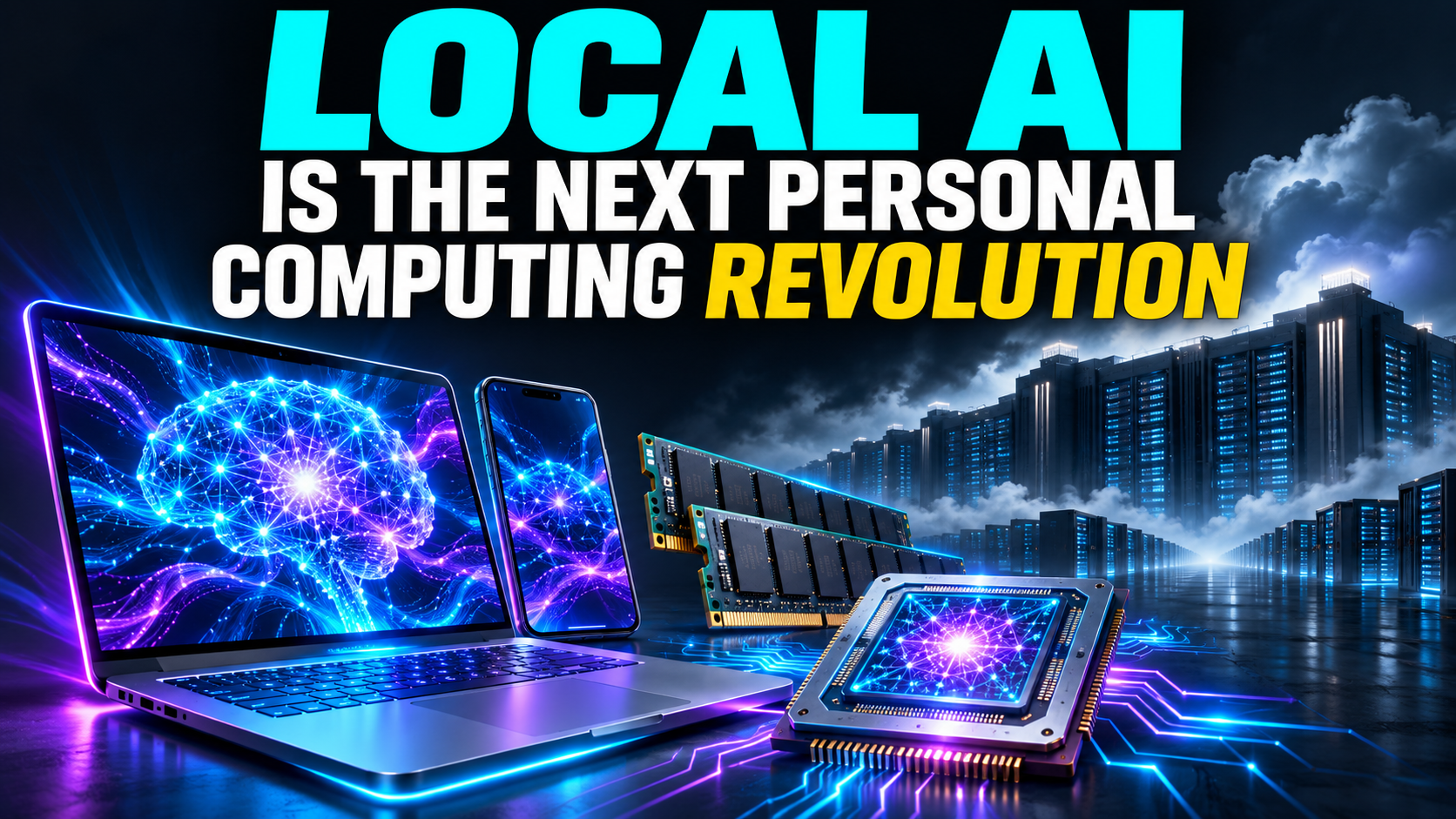
A recent report about Sam Altman’s comments on device memory framed unused RAM in local machines as a poor use of a scarce resource when that memory could be serving AI workloads in the cloud. There is a real infrastructure constraint underneath that argument. AI has made memory, accelerators, power, networking, cooling, and data-center capacity strategically important. It is not hard to understand why companies building frontier models want more of all of them.
But I think the conclusion needs more context.
The question is not whether AI needs more memory. It absolutely does. The question is where that memory creates the most value as AI becomes a normal part of personal and professional computing.
From the perspective of a cloud AI provider, RAM sitting in millions of laptops and phones can look underutilized. From the perspective of the person using those devices, that same memory is the foundation for a future where capable AI is fast, private, affordable, and available even when a cloud connection is not the best answer.
That is not an argument against OpenAI, Anthropic, or cloud AI. Frontier models will remain enormously important. It is an argument against treating centralized AI as the only meaningful destination for computing resources.
I believe the next phase of AI will be hybrid: local models will handle far more everyday work, while cloud models will be used deliberately for the capabilities that actually require frontier-scale infrastructure.
There Really Is a Resource Problem
It is important not to dismiss the underlying concern. AI is exposing resource limits that were easy to ignore when most consumer software was built around browsers, office applications, streaming media, and conventional games.
Large language models are memory-hungry. So are image models, video models, retrieval systems, agent workflows, and the supporting infrastructure required to serve millions of users at low latency. Training the largest models requires vast clusters of accelerators and enormous amounts of high-bandwidth memory. Inference, which is the process of actually responding to users, also consumes significant memory capacity at scale.
That demand affects the broader hardware market. Memory is no longer only a specification people check when buying a laptop or configuring a server. It is a major constraint across the entire AI supply chain. When demand grows faster than supply for the memory architectures AI workloads need, costs rise and capacity becomes harder to obtain.
So yes, more memory is needed.
But it does not follow that local memory is wasted simply because it is not being consumed every second of the day. A laptop is not a miniature data center that failed to rent out all of its capacity. It is a personal tool that must be responsive when its owner needs it. The fact that a device has available resources between tasks is part of what makes computing feel immediate rather than congested.
We would not say the empty seat in a car is wasted because it could have been used as a taxi at that moment. Personal ownership creates availability, control, and convenience that shared infrastructure cannot always provide.
Memory in personal devices will create the same kind of value as AI moves closer to the user.
The Cloud Provider Lens Looks Familiar
This is where I think the conversation starts to sound a little like the old mainframe mindset.
Centralized computing has clear advantages. It can pool expensive resources, operate specialized hardware, deliver updates quickly, and make the most capable systems available without every customer needing to own a supercomputer. That is a powerful model, and it is exactly why cloud computing became so important.
But the history of computing is not a story of centralization winning permanently. It is a story of the balance moving back and forth.
We had mainframes. Then personal computers put meaningful compute power on desks. The internet and the cloud centralized many workloads again. Smartphones put powerful computers in our pockets. Now AI is creating another shift: software increasingly needs accelerated compute and large amounts of memory close to the person, their data, and their workflow.
I wrote earlier about AI becoming personal computing all over again. This memory discussion makes that transition even clearer. If AI is only something that happens in a remote data center, then users will always be dependent on a provider, a network connection, a service plan, a rate limit, and the provider’s choices about what the model can do.
That will work for many situations. It will not be enough for all of them.
A local model can respond without network latency. It can work with private files without shipping all of that context to a third party. It can remain available during an outage or while traveling. And once the hardware has been purchased, it can handle routine tasks without creating an additional per-request cloud cost.
Those properties matter to individuals, developers, businesses, and organizations with sensitive data.
Local AI Is Moving Faster Than Most People Expect
I do not think enough people are thinking seriously about local AI yet.
The broader pattern is familiar. As computing became smaller, less expensive, and more power-efficient, capabilities that once required a room-sized computer eventually fit into a device in your pocket. A modern smartphone has dramatically more computing capability than the systems that once defined enterprise computing. That transition did not eliminate centralized computing, but it changed who could use it, where it could be used, and what people could build with it.
AI is beginning to follow the same path. Models that would have been impractical to run anywhere but a data center only a few years ago can now run on a laptop, and increasingly on a phone. They are not always equivalent to the very latest frontier models, and benchmark comparisons need to be made carefully. But the important trend is undeniable: useful AI capability is moving rapidly onto personal hardware.
Over the next several years, I expect local AI to expand quickly and disrupt industries that currently assume every intelligent feature must call a remote service. When useful AI runs where the user works and where the data already lives, applications can be faster, more private, more available, and less expensive to operate at scale. That creates room for entirely different products and workflows.
In that sense, I see OpenAI and Anthropic today in a position that is reminiscent of IBM in the 1970s: they operate some of the most powerful and consequential computing systems of their era. That is not a prediction that they will disappear, nor is it a claim that history repeats perfectly. IBM remained important long after the personal computer arrived. The point is that personal computing changed the industry by distributing capability into the hands of far more people.
I believe local AI is the start of a comparable transition. The major disruption will not come only from the largest cloud models becoming more capable. It will come when useful models are built into the machines people already own and developers can assume that AI capability is available near the user by default.
Most AI Tasks Do Not Need a Frontier Model
The best cloud models are impressive because they handle difficult reasoning, broad knowledge, sophisticated coding, long context, complex multimodal work, and difficult open-ended problems. There will continue to be tasks where a frontier model is the right tool.
However, the average AI interaction does not always need the most expensive model available.
A model running locally can already be useful for tasks such as:
- Drafting, rewriting, and summarizing text
- Searching and organizing personal documents
- Extracting information from local files
- Classifying emails, notes, images, or support tickets
- Translating text and improving accessibility
- Assisting with code completion and explaining code in a local repository
- Transcribing and summarizing meetings
- Running small automations with private local context
- Generating or editing images when an appropriate local model and hardware are available
These are not trivial use cases. They are the daily work of millions of people. And they are exactly the kind of work where latency, privacy, availability, and marginal cost influence whether AI becomes a habit or remains a special destination people visit in a browser tab.
The model does not need to be the most capable model in the world. It needs to be capable enough for the task.
That is an important engineering principle. We do not deploy the largest possible database, CPU cluster, or distributed system for every application. We choose an architecture that fits the workload. AI should be treated the same way.
There is one important caveat: a local language model does not automatically make research or fact-checking reliable. A model can summarize material stored on a device or help formulate a question, but it cannot know what changed this morning unless it has a trusted, current source of information. For up-to-date research, authoritative verification, and broad web retrieval, a cloud service or external data source will still often be necessary.
That does not weaken the local-AI case. It clarifies it.
The sensible workflow is often local-first, not local-only. A local model can prepare, filter, summarize, protect private context, and decide when the task needs outside information. Then a cloud model or trusted search and retrieval service can be used for the portion that genuinely benefits from it.
Local First Does Not Mean Cloud Never
I do not expect local LLMs to eliminate OpenAI, Anthropic, Google, Microsoft, or any other provider of frontier models. In fact, the growth of local AI will likely make the cloud services more valuable for the harder tasks.
The future is not one model running everywhere. It is a layered architecture.
A local model may sit in the operating system, development environment, phone, or application. It handles routine language tasks, personal context, and immediate interactions. It can keep sensitive information on the device and offer a fast response without a network round trip.
When the task requires a larger context window, deeper reasoning, fresh information, a specialized capability, large-scale processing, or collaboration across an organization, the application can escalate to the cloud. The cloud model becomes a higher-capability service, not the default destination for every small request.
That model resembles how we already build systems. Caches handle frequent reads close to the user. Edge services handle work near the request. Local storage gives applications responsiveness and resilience. Central systems handle shared state, heavier processing, coordination, and scale.
AI will follow a similar pattern.
The shift is not about declaring a winner between the laptop and the data center. It is about using the right resource at the right layer.
The cloud will remain essential for frontier AI, but personal devices will become essential for making AI truly personal.
Memory Is Now a First-Class AI Requirement
For decades, most people evaluated a new computer using a familiar list: processor speed, storage capacity, screen size, battery life, and perhaps graphics performance for gaming or creative work. RAM mattered, but it was often treated as a background specification. Buy enough to run the operating system and applications comfortably, and move on.
AI changes that.
Local models need memory to hold their parameters, their working context, and the rest of the software running on the device. Image-generation and other generative workloads add more demand. If the required memory is not available, the experience can become slow, constrained, or impossible to run locally at all.
This is why devices designed for local AI need more than an AI sticker on the box. They need a memory architecture that recognizes the CPU, GPU, and AI accelerators are no longer isolated specialties. They are increasingly cooperating on the same workloads.
In traditional PCs, system RAM and graphics memory were commonly separate pools. The CPU used one pool. A discrete graphics card used another. That design made sense for many workloads, but it can introduce friction when data needs to move between processors. A model, its input, or an intermediate result may need to be copied from one memory space to another. Those transfers cost time, energy, and usable capacity.
Unified memory takes a different approach. Rather than treating CPU memory and GPU memory as entirely separate resources, the machine can provide a shared memory architecture that processors use together. There are engineering tradeoffs, and implementations vary, but the general benefit for AI is clear: the system can avoid unnecessary copying and allocate memory more flexibly to the part of the workload that needs it.
That matters because a device does not need unused CPU RAM on one side and insufficient GPU memory on the other. It needs its available memory to work as effectively as possible across the whole system.
I believe unified memory, or architectures that achieve the same practical flexibility, will become increasingly important for local AI. It can make a machine more efficient, more capable, and potentially less expensive than a design that requires oversized, separately provisioned memory pools just to accommodate AI workloads.
This is not a claim that every device needs one identical hardware design. Discrete GPUs will continue to make sense for many high-performance workloads. Servers will continue to use specialized accelerators and memory designs. But for broad personal computing, the direction is toward machines designed as AI systems from the start, not conventional machines with an AI component bolted on at the end.
We Have Seen This Kind of Upgrade Cycle Before
The industry has been through hardware transitions driven by software before.
When Windows Vista arrived, its graphical user interface made GPU capability much more visible to ordinary users. A computer that was sufficient for earlier versions of Windows could feel dated quickly. The operating system’s expectations changed, and people discovered that their existing hardware was not always ready for the new experience.
AI will create a similar transition, although the limiting resource will often be memory capacity and memory bandwidth rather than graphics features alone.
A machine that is perfectly capable for email, documents, web browsing, and video calls may not have enough memory to run a useful local model alongside the rest of a modern workflow. A system with an accelerator but too little accessible memory may still provide only a narrow AI experience. And a device designed around separate, inflexible memory pools may leave capability stranded in the wrong place.
This will influence how people judge a device’s useful life. It is no longer enough to ask whether a machine runs today’s software. We also need to ask whether it has enough flexible, high-performance memory for the AI capabilities that software will increasingly expect tomorrow.
That is a larger shift than adding a graphics card to an old desktop.
The Better Goal Is More Capable Personal Machines
We should absolutely build more AI infrastructure. Frontier research, enterprise workloads, scientific work, and large-scale services need it. Better cloud capacity will benefit many people.
But reducing the amount of capable hardware in people’s hands would be the wrong response to scarcity.
The long-term opportunity is to build more capable personal machines with more memory, better memory bandwidth, and architectures that can intelligently share those resources across CPUs, GPUs, and AI accelerators. Those machines will not replace data centers. They will reduce unnecessary dependence on them.
That is good for privacy. It is good for responsiveness. It is good for resilience. It is good for experimentation. And it gives people more control over how and where their own data is processed.
The AI future I expect is not a return to a world where all computing happens in a remote facility owned by a small number of providers. It is a hybrid world where frontier intelligence remains in the cloud, while everyday intelligence becomes a normal capability of the devices we own.
AI needs more memory. That part is undeniable.
But the answer is not to assume every useful byte must be concentrated in a data center. The answer is to recognize that memory in personal devices is about to become one of the most important enablers of personal AI.